
Last updated: November 7, 2026
Table of contents
- Quick Answer
- Key Takeaways
- Quick Picks at a Glance
- What Siemens NX Actually Needs in 2026
- Certified vs. Gaming GPU for NX: A Straight Answer
- The NX Workload-to-Hardware Map
- The SPECviewperf snx Comparison: The Number That Matters Most for NX
- Side-by-Side Comparison
- The 5 Best Laptops for Siemens NX in 2026
- 1. Dell Pro Max 16 Plus : Best Overall Laptop for Siemens NX
- 2. Lenovo ThinkPad P1 Gen 9 : Best Portable Laptop for Siemens NX
- 3. HP ZBook Fury G1i 18 : Best Big-Screen Laptop for Large NX Assemblies
- 4. MSI Raider 16 Max HX : Fastest Single-Core CPU, but Uncertified
- 5. Razer Blade 16 (2026) : Thinnest Laptop with 24GB of VRAM, but Uncertified
- Laptops I Left Out on Purpose
- How I Evaluated These Laptops
- NX Buyer’s Checklist: Licensing, OS and Driver Pitfalls
- Frequently Asked Questions
- Final Verdict
- Sources
You can spend $5,000 on a laptop that tops every gaming chart, open a 3,000-part assembly in Siemens NX, and watch the viewport stutter. If the screen then starts glitching and you file a ticket, Siemens support can close it without fixing anything.
That isn’t a scare story. It’s what Siemens’ own release notes allow. If a graphics or display problem can’t be reproduced on a certified workstation, it isn’t supported. Most “best laptop for CAD” lists skip this part. They rank machines by gaming frame rates and Cinebench scores, and those tell you very little about how NX will feel on a Tuesday afternoon when the feature tree rebuilds and your manager is watching the design review.
2026 has also made the choice harder. NX now ships under a new name: the June 2026 release is called Designcenter (version 2606). Intel split its laptop chips into two families. NVIDIA launched an ARM chip that is excellent for AI and can’t run NX. And plenty of articles still recommend workstations from 2023 that have long been replaced.
So I started from scratch. I began with what Siemens itself says NX needs and worked out which part of the laptop each NX task actually loads. Then I chose five current-generation laptops, one per brand. Every number in this guide comes from a named, published, independent source. The best one gets within about 11% of a desktop RTX PRO 6000 in the official Siemens NX graphics benchmark. Most people don’t expect a 16-inch laptop to get that close, but the numbers show it does.
Quick Answer
The best laptop for Siemens NX in 2026 is the Dell Pro Max 16 Plus with the NVIDIA RTX PRO 5000 Blackwell. It has the highest published laptop score in SPECviewperf 15’s Siemens NX viewset (snx-05): 109.24 at 1080p and 95.86 at 4K. It’s ISV-certified, and it scales to 128GB of RAM and three Gen5 SSDs.
If you travel a lot, the Lenovo ThinkPad P1 Gen 9 is the smarter buy. It’s Siemens-certified, certified for Linux, under 2kg, and it ran for more than 22 hours in Notebookcheck’s Wi-Fi battery test.
Key Takeaways
- Certification matters more in NX than in most CAD programs. Siemens doesn’t support graphics or performance issues that can’t be reproduced on certified hardware.
- Each component handles a different part of the job. Single-core CPU speed decides how quickly models rebuild, the GPU decides how smooth the viewport is, and RAM decides how big an assembly you can open comfortably.
- Resolution changes how much GPU you need. In official snx-05 results, an RTX PRO 3000 laptop dropped from 102.61 at 1080p to 55.23 at 4K. The RTX PRO 5000 laptop held 95.86 at 4K.
- x86 only. Siemens says NX/Designcenter isn’t supported on ARM-based Windows, and some tools, including Measure, don’t work there. macOS isn’t a native NX platform.
- RAM: Siemens recommends 32GB or more and says to install as much as the machine will take. For real assemblies I treat 64GB as the practical starting point.
Quick Picks at a Glance
| Award | Laptop | Why it wins |
|---|---|---|
| Best overall for NX | Dell Pro Max 16 Plus | Top laptop SPECviewperf snx-05 score, 24GB RTX PRO 5000, 3x Gen5 M.2, CAMM2 RAM |
| Best portable NX workstation | Lenovo ThinkPad P1 Gen 9 | Siemens ISV-certified, 22+ hour battery result, 1.947kg as tested |
| Best big-screen for large assemblies | HP ZBook Fury G1i 18 | 18-inch 165Hz panel, 4x SODIMM and 4x NVMe slots, up to RTX PRO 5000 |
| Fastest single-core CPU (uncertified) | MSI Raider 16 Max HX | Highest Geekbench 6 and Cinebench single-core scores here, upgradeable SODIMM RAM |
| Thinnest 24GB-VRAM option (uncertified) | Razer Blade 16 (2026) | RTX 5090 24GB in a 17.4mm, 2.12kg chassis |
What Siemens NX Actually Needs in 2026
The current version and operating systems
The latest major release came out in June 2026 under the new name Designcenter, release 2606. Siemens’ Designcenter buyer’s guide lists these operating systems for it:
- Supported: Windows 11, Windows Server 2022, RedHat/Rocky Linux 8.10, SuSE Linux 15
- Limited support: Windows 10, Windows Server 2019, RedHat Linux 8, RedHat/Rocky Linux 8.9
The same Siemens page also says, a few lines above that Linux list, that Designcenter is Windows-only. I read that as a template error on the page, because NX has supported Linux for years. If your team runs Linux, confirm with your Siemens reseller before you buy anything.
macOS isn’t supported, and neither is ARM Windows. A Siemens knowledge base article says NX/Designcenter isn’t supported on ARM-based Windows platforms. It specifically mentions the Measure tool and other features failing on a Snapdragon X Elite laptop.
Hardware requirements (from Siemens)
| Spec | Minimum | Recommended |
|---|---|---|
| RAM | 8GB | 32GB or more; install as much as the system supports |
| Disk | 9.0GB for installation | 9.0GB for installation |
| Color depth | 65K colors | True Color (32-bit) or 24-bit |
| Resolution | 1920 x 1080 | 1920 x 1080 or higher |
| Video RAM | 2GB | 2GB or more on a certified card |
| Graphics | Card in a Siemens-certified HP, Dell, Lenovo, Fujitsu, MSI or Siemens workstation, as configured by the OEM | Same, with the recommended driver. Siemens doesn’t certify external GPUs and has no plans to. |
Those minimums are enough to start NX, not enough to work in it. Siemens’ NX release notes say most hardware-related problems turn out to be graphics problems, which is why it insists on OpenGL-capable cards with strong vendor support. Siemens keeps an NX Graphics Certification Table in its Hardware and Software Certifications portal. You need a login or a reseller to see it, but it’s worth checking your exact model and driver there before you buy.
Certified vs. Gaming GPU for NX: A Straight Answer
People ask me this more than anything else, so here is the short version.
Yes, a GeForce RTX 5090 laptop will run NX. It’s an x86 Windows machine with a powerful OpenGL GPU, and plenty of students and freelancers work that way.
You are taking on three risks, though:
- Support. Siemens’ release notes say graphics, display and performance issues aren’t supported unless you can reproduce them on certified hardware. If your viewport starts glitching, they can close the ticket.
- Drivers. Certified configurations use NVIDIA’s workstation (RTX Enterprise) drivers, which Siemens tests. Gaming laptops ship with Game Ready or Studio drivers, which update whenever a big game comes out.
- Memory. Many thin gaming laptops have soldered RAM. The Razer Blade 16 that Notebookcheck tested had 32GB of soldered LPDDR5X. That is Siemens’ recommended floor, and you can never upgrade it.
What you get with RTX PRO Blackwell: certified drivers, ECC-capable VRAM on the higher tiers, and more VRAM at each price point. Notebookcheck lists the RTX PRO 5000 Blackwell laptop GPU with 10,496 CUDA cores and 24GB of GDDR7. The RTX PRO 3000 has 5,888 cores and 12GB with ECC. The RTX PRO 2000 has 3,328 cores and 8GB.
My rule: if NX pays your bills, buy certified. If NX is coursework or a side tool and you also game or run AI models, a GeForce laptop is a reasonable choice as long as you know what you’re giving up.
The NX Workload-to-Hardware Map
I wish every NX buyer saw this table before opening a configurator. It matches what you actually do in NX to the component that limits it.
| NX task | Main bottleneck | What to prioritize | Configuration I’d target |
|---|---|---|---|
| Part modeling, sketching, feature edits | Single-core CPU | Highest boost clock | Core Ultra 9 285HX / 290HX Plus or Core Ultra 9 386H |
| Moving around large assemblies (rotate, pan, zoom) | GPU and VRAM, then RAM | RTX PRO 3000 or higher; more VRAM for 4K | RTX PRO 3000–5000, 64GB+ RAM |
| Loading huge assemblies or Teamcenter data | RAM and NVMe | Capacity first, then a fast Gen5 SSD | 64–128GB RAM, Gen5 NVMe, second SSD for data |
| Drafting large assemblies | Single-core CPU and RAM | Fast cores, plenty of memory | Same as modeling, plus 64GB |
| Simcenter / CAE meshing and solving | Multi-core CPU and RAM | Core count, sustained power, RAM | 24-core HX CPU, 96–128GB+ RAM |
| CAM toolpaths and simulation | Multi-core CPU plus GPU | Balanced | HX CPU, RTX PRO 3000+ |
| Ray Traced Studio rendering | GPU | As much GPU and VRAM as you can afford | RTX PRO 5000 24GB |
| Travel, design reviews, light edits | Battery, weight, certification | Efficiency | Panther Lake + RTX PRO 2000 |
About the RAM column: Siemens doesn’t publish a “this many GB for this many parts” chart, and I’m not going to make one up. What Siemens does say is 32GB or more, and as much as the machine can hold. In practice that means buying a laptop whose RAM you can upgrade later, which is why CAMM2, LPCAMM2 and SODIMM slots matter so much in the picks below.
The SPECviewperf snx Comparison: The Number That Matters Most for NX
SPECviewperf’s snx viewset replays real graphics traces recorded from Siemens NX. It’s the closest thing there is to an NX-specific GPU benchmark, but most laptop roundups never mention it. These are the official SPECviewperf 15 snx-05 results from SPEC.org’s results overview (updated April 30, 2026):
| System | GPU | snx-05 (1080p) | snx-05 (4K) |
|---|---|---|---|
| Dell Pro Max 16 Plus (Core Ultra 9 285HX) | RTX PRO 5000 Blackwell Laptop | 109.24 | 95.86 |
| Dell Pro Max 16 Premium (Core Ultra 9 285H) | RTX PRO 3000 Blackwell Laptop | 102.61 | 55.23 |
| Lenovo ThinkPad P1 Gen 8 (Core Ultra 9 285H) | RTX PRO 2000 Blackwell Laptop | 100.94 | Not submitted |
| HP Z2 Mini G1a (Ryzen AI Max+ PRO 395) | Radeon 8060S (integrated) | 89.07 | Not submitted |
| Dell Pro Max Tower T2 (desktop) | RTX PRO 6000 Blackwell Workstation | 120.40 | 107.59 |
| HP Z2 Tower G1i (desktop) | RTX PRO 5000 Blackwell (desktop) | 125.02 | 111.13 |
What I take from this:
- At 1080p the scores are close. The RTX PRO 2000 laptop reached about 92% of the RTX PRO 5000 laptop’s score. At that resolution the NX viewport is partly held back by the CPU and driver, so a mid-range certified GPU feels close to a flagship one.
- At 4K the gap gets huge. The RTX PRO 3000 laptop fell to 55.23, while the RTX PRO 5000 laptop held 95.86, about 74% higher. If you’ll work on a 4K laptop screen or a 4K monitor, the GPU tier matters a lot.
- The best laptop gets within about 11% of a desktop RTX PRO 6000 at 4K (95.86 vs. 107.59). That’s a remarkable result for a 16-inch machine.
Notebookcheck’s older SPECviewperf 2020 snx-04 runs show the same kind of jump between generations. The Dell Pro Max 16 Plus scored 545.61 fps at 4K, compared with 362.19 fps for an HP ZBook Fury 16 G10 with the previous-generation RTX 5000 Ada.
Note: The ThinkPad P1 Gen 9 doesn’t have its own snx-05 submission yet. I list the P1 Gen 8 because it uses the same RTX PRO 2000 GPU in essentially the same chassis. Treat it as a close stand-in, not an official Gen 9 result.
Side-by-Side Comparison
| Dell Pro Max 16 Plus | Lenovo ThinkPad P1 Gen 9 | HP ZBook Fury G1i 18 | MSI Raider 16 Max HX | Razer Blade 16 (2026) | |
|---|---|---|---|---|---|
| CPU (tested) | Core Ultra 9 285HX | Core Ultra 9 386H / Ultra 7 366H | Core Ultra 9 285HX | Core Ultra 9 290HX Plus | Core Ultra 9 386H |
| Top GPU | RTX PRO 5000 24GB | RTX PRO 2000 8GB | RTX PRO 5000 24GB | GeForce RTX 5090 24GB | GeForce RTX 5090 24GB |
| ISV-certified | Yes | Yes (Siemens listed) | Yes (RTX PRO) | No | No |
| RAM | Up to 128GB CAMM2 | Up to 96GB LPCAMM2 | 4x SODIMM (64GB tested) | 2x SODIMM (32GB tested) | 32GB soldered |
| SSD slots | 3x M.2 Gen5 | 2x M.2 (Gen5 + Gen4) | 4x NVMe | 2x M.2 (Gen5 + Gen4) | 1 (2TB tested) |
| Display (tested) | 16″ 4K OLED 120Hz | 16″ 1920×1200 IPS | 18″ 2560×1600 IPS 165Hz | 16″ 2560×1600 OLED 240Hz | 16″ 2560×1600 OLED 240Hz |
| Measured brightness | 540 nits | 495 nits | 497 nits | 481 nits | 465 nits |
| Single-core CPU result | CB R23 2,057 / GB6 2,907 | Cinebench 2026: 519.9 | CB R23 2,190 / GB6 3,010 | CB R23 2,356 / GB6 3,149 | CB R23 2,087 / GB6 2,886 |
| Battery test | 2h 37m (Trusted Reviews) | 22+ hrs Wi-Fi (Notebookcheck) | 6h 29m Procyon (HP-commissioned) | 8h 34m (Tom’s Hardware) | 17h 20m web (Hardware Canucks) |
| Battery capacity | 96Wh | 90Wh | 99Wh | 91.8Wh | 90Wh |
| Weight (tested) | 2.845kg | 1.947kg | 3.43kg | 2.655kg | 2.124kg |
| Price (as reviewed) | ~$5,000 | ~$5,100 | $5,660 to $10,000+ | $4,099 list | $4,900 |
The 5 Best Laptops for Siemens NX in 2026
1. Dell Pro Max 16 Plus: Best Overall Laptop for Siemens NX
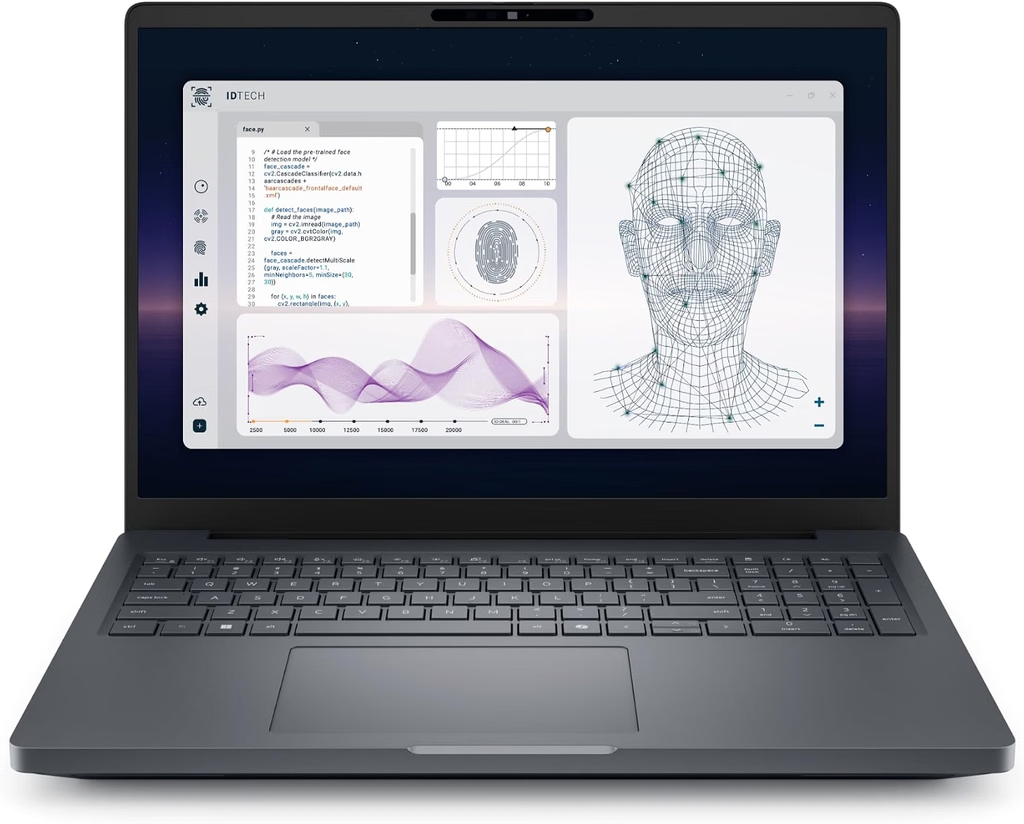
If someone gave me a budget and asked for the fastest certified NX laptop available, this is what I’d configure. It’s the only laptop I found with official SPEC.org snx-05 results at both 1080p and 4K, and it has the top score in both.
Specs:
- CPU: Intel Core Ultra 5 245HX / Ultra 7 265HX / Ultra 9 285HX (24 cores, up to 5.5GHz), all with vPro Enterprise
- GPU: Up to NVIDIA RTX PRO 5000 Blackwell with 24GB GDDR7 (rated up to 175W, on a removable GPU module)
- RAM: Up to 128GB DDR5-6400 CAMM2 (StorageReview)
- Storage: Up to three M.2 Gen5 SSDs at 4TB each, with RAID 0/1/5 support
- Display: 16-inch 16:10. Choose 1920×1200 at 300 nits, 1920×1200 at 500 nits / 120Hz / 100% DCI-P3, or 3840×2400 OLED touch at 120Hz
- Battery: 96Wh, 6-cell
- Weight: From 5.63 lb (Dell); 2.845kg as tested by Notebookcheck
- Ports: 2x Thunderbolt 5, 1x Thunderbolt 4, 2x USB-A, HDMI 2.1, 2.5GbE RJ45, SD reader, optional smart card reader, Wi-Fi 7
- OS: Windows 11 Pro or Ubuntu 24.04 LTS
- Price: Notebookcheck’s top test configuration (Core Ultra 9 285HX, RTX PRO 5000, 4K OLED, 2TB Gen5, 128GB) came in around $5,000. StorageReview’s fully loaded unit was about $8,900. Dell’s US store has listed the Pro Max 16 Plus from $3,395.
- ISV certification: Yes. StorageReview reports more than 100 ISV certifications.
Published benchmarks:
- SPECviewperf 15 snx-05: 109.24 at 1080p / 95.86 at 4K (SPEC.org)
- SPECviewperf 2020 snx-04: 737.19 fps at 1080p / 545.61 fps at 4K (Notebookcheck)
- Cinebench 2024: 1,907 multi / 126.3 single (Notebookcheck)
- Cinebench R23: 35,165 multi / 2,057 single (Notebookcheck)
- Geekbench 6: 20,630 multi / 2,907 single (Notebookcheck)
- 3DMark: Time Spy 22,205; Steel Nomad 6,021; Speed Way 6,389 (Notebookcheck)
- Display (4K OLED): 540 nits average, 556.8 peak, 97.3% Display P3, 100% sRGB, Delta E 2.42 (0.7 after calibration) (Notebookcheck)
- Thermals: Notebookcheck saw the CPU hit roughly 95–105°C under stress. The GPU settled around 125W in sustained loads, below its 175W rating.
- Battery: 2 hours 37 minutes in Trusted Reviews’ test; 5 hours 18 minutes in IT Pro’s light video test at 170 nits
Why I like it for NX: It covers the demanding end of the workload map completely. You get the fastest certified laptop GPU, a 24-core CPU, upgradeable CAMM2 memory, and three Gen5 slots, so the OS, the NX install and your project data can each have their own drive. StorageReview noted that the fans kept temperatures under control without becoming a constant drone.
Pros:
- Highest published laptop snx-05 score at both 1080p and 4K
- 24GB of VRAM handles big assemblies and Ray Traced Studio comfortably
- Three Gen5 M.2 slots with RAID 5 support
- Upgradeable CAMM2 RAM and a removable GPU module
- Excellent 4K OLED option, plus a factory Ubuntu option for Linux shops
- Three-year next-business-day onsite warranty standard (StorageReview)
Cons:
- Heavy, and it comes with a big 280W power brick
- Battery life drops fast under any real workload
- The CPU runs very hot (95–105°C) under stress
- The GPU doesn’t sustain its full 175W rating
- The price climbs quickly once you add the RTX PRO 5000
Who should buy it: NX power users working on large assemblies, Simcenter users who also want the strongest viewport, and anyone working at 4K.
2. Lenovo ThinkPad P1 Gen 9: Best Portable Laptop for Siemens NX
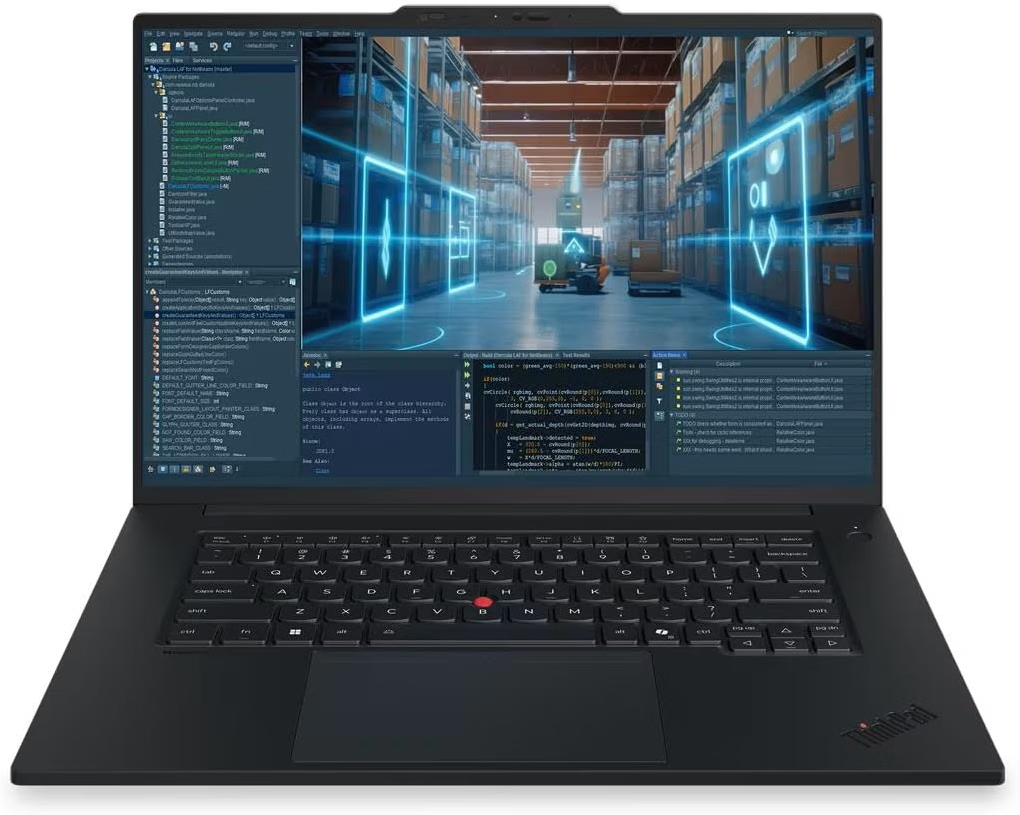
This is the one I’d carry myself. Lenovo announced it in March 2026 and started shipping in June. It moved from Arrow Lake-H to Intel’s Panther Lake, and it’s the first P1 that really lasts a full workday.
Specs:
- CPU: Intel Core Ultra Series 3 (Panther Lake): Core Ultra 7 356H, Ultra 7 366H, Ultra 9 386H for RTX PRO configurations. The X7 368H and X9 388H come with integrated graphics only.
- GPU: NVIDIA RTX PRO 1000 or RTX PRO 2000 Blackwell, 8GB GDDR7
- RAM: 16–96GB LPDDR5X-8533 on a user-replaceable LPCAMM2 module
- Storage: Two M.2 2280 slots (one PCIe 5.0 x4, one PCIe 4.0 x4), up to 8TB, RAID 0/1
- Display options: 16″ 1920×1200 IPS at 500 nits; 16″ 3840×2400 IPS at 800 nits with 100% DCI-P3 and X-Rite calibration; 16″ 3.2K Tandem OLED touch at 120Hz with up to 1,500 nits HDR peak
- Battery: 90Wh, user-replaceable, with a 140W USB-C GaN charger
- Weight: From 1.77kg (Lenovo); 1.947kg as tested by Notebookcheck
- Ports: 2x Thunderbolt 5, 1x Thunderbolt 4, 1x USB-A 10Gbps, HDMI 2.1, SD Express 7.0, 3.5mm audio, optional 5G. There’s no built-in Ethernet.
- OS: Windows 11 Pro; certified for Ubuntu, Fedora and Red Hat Enterprise Linux 10.2
- Price: Build-your-own starts at $3,734 (StorageReview, October 2026). Notebookcheck’s test unit came to about $5,100. Lenovo discounts often.
- ISV certification: Yes, including Siemens (StorageReview spec table)
Published benchmarks:
- Battery: More than 22 hours in Notebookcheck’s 150-nit Wi-Fi test (Core Ultra 7 366H / RTX PRO 2000 / 1920×1200). Older P1 models typically managed five to ten hours.
- Cinebench 2026 (Core Ultra 9 386H): 5,083 multi / 519.9 single, about 18% ahead of the Core Ultra 9 285H in multi-core (StorageReview)
- Sustained performance: In a 30-minute Cinebench loop it held 98.3% of its first-run score, with the CPU peaking around 94°C (StorageReview)
- Memory bandwidth: 81,712MB/s in STREAM Triad vs. 62,255MB/s on the 285H (StorageReview)
- SSD (SK hynix 2TB Gen5): 10,012MB/s sequential read, 9,203MB/s sequential write (StorageReview)
- Display (1920×1200 IPS): about 495 nits average (Notebookcheck)
- NX GPU proxy: The P1 Gen 8, with the same RTX PRO 2000, scored 100.94 in SPECviewperf 15 snx-05 at 1080p (SPEC.org)
- Rating: 91%, “very good” (Notebookcheck)
One discrepancy you should know about: Notebookcheck’s unit ran the RTX PRO 2000 at 75W (including 60W of Dynamic Boost), while StorageReview’s unit was set to 50W. GPU power seems to vary by configuration or firmware, so expect viewport performance somewhere between those two.
Why I like it for NX: For part modeling, drafting, design reviews and mid-sized assemblies at 1080p to 1600p, the RTX PRO 2000 is enough. The snx-05 data puts it within about 8% of the RTX PRO 5000 laptop at 1080p. Add Panther Lake’s efficiency, Siemens certification, Linux certification and replaceable LPCAMM2 memory, and you get the most balanced NX laptop of 2026.
Pros:
- Siemens ISV-certified, and RHEL 10.2 certified for Linux NX users
- Exceptional battery life for a laptop with a discrete GPU
- Light for a 16-inch workstation, with a premium aluminum build
- Thunderbolt 5, SD Express, two SSD slots and upgradeable RAM
- One of the best keyboards and input setups in its class (Notebookcheck)
Cons:
- The GPU tops out at an RTX PRO 2000 with 8GB of VRAM, which isn’t enough for heavy viewport work at 4K
- 96GB RAM ceiling
- The chassis gets hot under load (Notebookcheck)
- No built-in Ethernet port
- List prices are high, so it’s worth waiting for a sale
Who should buy it: Mechanical designers, consultants and engineers who spend a lot of time away from a desk, and anyone running NX on Linux.
3. HP ZBook Fury G1i 18: Best Big-Screen Laptop for Large NX Assemblies
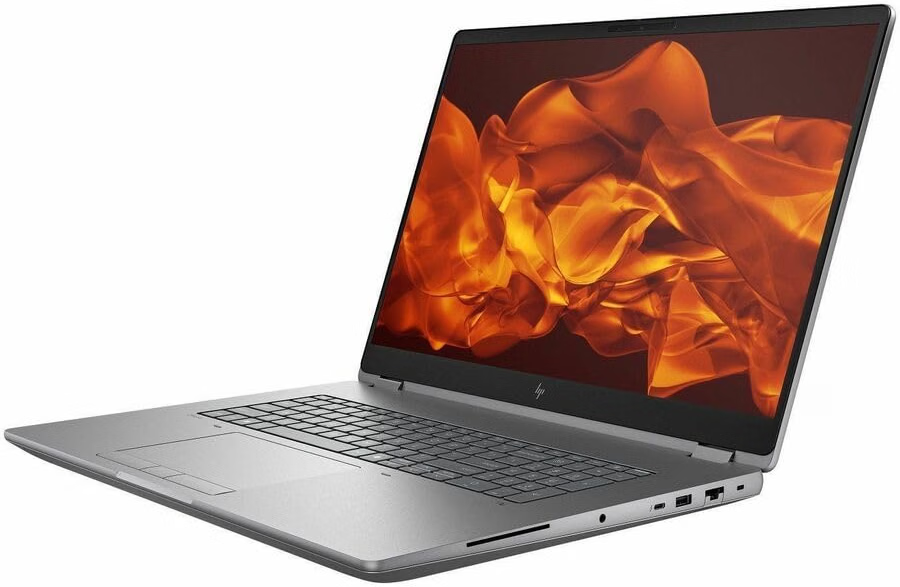
When you spend all day in big assemblies and detailed drawings, more screen area saves real time. The Fury G1i 18 is HP’s first 18-inch Fury, and it has more room for expansion than anything else on this list.
Specs:
- CPU: Up to Intel Core Ultra 9 285HX (24 cores)
- GPU: RTX PRO 1000 / 2000 / 3000 / 4000 / 5000 Blackwell (the RTX PRO 5000 runs at 150W with 24GB)
- RAM: Four SODIMM slots (64GB DDR5-5600 tested)
- Storage: Room for four NVMe SSDs
- Display: 18-inch 2560×1600 IPS, 165Hz, matte
- Battery: 99Wh
- Weight: 3.43kg, plus a 1.008kg power supply
- Ports: 2x Thunderbolt 5, 1x Thunderbolt 4, USB-A 10Gbps, HDMI 2.1, 2.5GbE RJ45, SD reader, smart card reader, 3.5mm audio
- Price: From $5,660 to more than $10,000 with the Core Ultra 9 285HX and RTX PRO 5000 (Notebookcheck)
- ISV certification: It’s an RTX PRO Blackwell workstation. Check Siemens’ table for your exact configuration.
Published benchmarks:
- Cinebench R23: 34,955 multi / 2,190 single (Notebookcheck)
- Geekbench 6: 3,010 single / 18,694 multi (StorageReview)
- PCMark 10: 8,667 (StorageReview)
- Display: 497 nits average, 517.5 peak, 96.6% Display P3, 100% sRGB, 1,617:1 contrast, Delta E 3.62 (0.85 after calibration), no PWM flicker detected (Notebookcheck)
- Battery: 6 hours 29 minutes in the Procyon Office Productivity battery test, from a Principled Technologies report that HP commissioned
- Rating: 90%, “very good” (Notebookcheck)
Why I like it for NX: Four SODIMM slots and four NVMe slots are rare in 2026, and they’re exactly what a big-assembly NX user needs. You can buy what you need today and expand later. Its single-core Cinebench R23 score is also slightly ahead of Dell’s 18-inch rival, and that’s the number that matters for feature rebuilds. It also has physical mouse buttons on the clickpad, which you’ll appreciate if you spend the day selecting and rotating geometry.
Pros:
- Huge 18-inch, 165Hz workspace
- Expandable to four SODIMM slots and four NVMe drives
- Built-in Ethernet and smart card reader
- Tool-less bottom panel for easy upgrades
- Clickpad with dedicated mouse buttons
Cons:
- At 3.43kg it’s a machine for moving between desks, not for carrying around all day
- Only a one-year warranty when bought from HP’s website (Notebookcheck)
- Loud under load, and there’s no OLED or 4K option
- CPU and GPU are slightly slower than Dell’s equivalent in multi-core tests
- Very expensive at the top configuration
Worth knowing: HP refreshed the 16-inch ZBook Fury G1i in 2026 with Arrow Lake HX Plus chips and up to 192GB of RAM, starting at $7,374 (Notebookcheck). If you want the Fury platform in a 16-inch size with enormous memory headroom, look at that version.
Who should buy it: Engineers who mostly work at a desk but move between sites, and anyone whose assemblies push RAM to the limit.
4. MSI Raider 16 Max HX: Fastest Single-Core CPU, but Uncertified
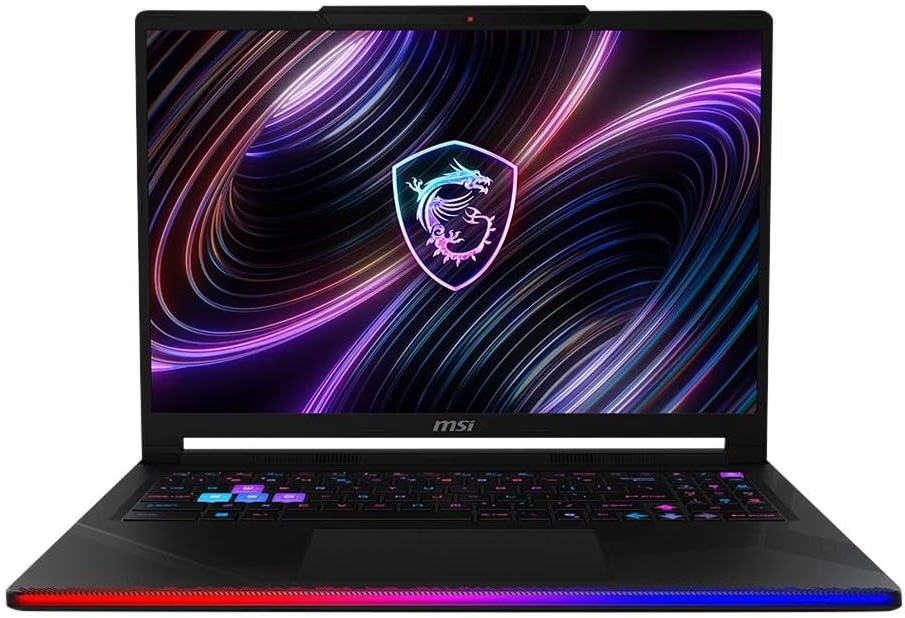
I want to be upfront here. MSI doesn’t sell a 2026 laptop with an RTX PRO Blackwell GPU. Its newest CreatorPro still uses the previous-generation RTX 5000 Ada, so I’m not recommending it. What MSI does have is the Raider 16 Max HX, and its single-core numbers are hard to ignore. Single-core speed is what makes NX feature rebuilds feel quick.
Specs:
- CPU: Intel Core Ultra 9 290HX Plus (24 cores, 8 performance cores up to 5.5GHz)
- GPU: Up to NVIDIA GeForce RTX 5090 Laptop with 24GB GDDR7 at 175W (RTX 5070 Ti and RTX 5080 versions also available)
- RAM: 32GB DDR5 in two SODIMM slots (as tested), upgradeable
- Storage: Two M.2 2280 slots (one PCIe 5.0, one PCIe 4.0) behind a dedicated upgrade panel
- Display: 16-inch 2560×1600 OLED, 240Hz, DisplayHDR 1000
- Battery: 91.8Wh
- Weight: 2.655kg; 1.335kg power adapter
- Ports: 2x Thunderbolt 4, 3x USB-A 10Gbps, HDMI 2.1, 2.5GbE RJ45, SD reader, 3.5mm audio, Wi-Fi 7
- Price: $2,999 with RTX 5070 Ti, $3,499 with RTX 5080, $4,099 list with RTX 5090 (Tom’s Hardware)
- ISV certification: No (GeForce)
Published benchmarks:
- Cinebench R23: 40,560 multi / 2,356 single (Notebookcheck)
- Cinebench 2024: 2,215 multi / 137.2 single (Notebookcheck)
- Geekbench 6: 20,699 multi / 3,149 single (Notebookcheck)
- SSD (Micron 2500 1TB): 6,943MB/s sequential read, 6,051MB/s sequential write in DiskSpd (Notebookcheck)
- Display: 481 nits average, 99.3% DCI-P3, 99.9% sRGB, Delta E 0.62 (Notebookcheck)
- Battery: 8 hours 34 minutes in Tom’s Hardware’s 150-nit Wi-Fi test
- Thermals: In a gaming stress test, Tom’s Hardware measured the CPU averaging 75°C and the GPU 72°C, with the keyboard surface peaking at 87°F
- Rating: 88%, “very good” (Notebookcheck)
Why it’s on the list: It posted the highest single-core scores of any laptop here: 3,149 in Geekbench 6 and 2,356 in Cinebench R23. For heavy part modeling and drafting, that’s a real advantage. Unlike the Razer, its RAM sits in SODIMM slots, so you can upgrade past 32GB yourself.
Pros:
- Fastest single-core performance in this roundup
- Upgradeable SODIMM RAM and two M.2 slots behind an easy-access panel
- Accurate, bright 240Hz OLED
- Good battery life for a 175W RTX 5090 machine
- Built-in 2.5GbE Ethernet
Cons:
- No ISV certification, so Siemens can decline graphics tickets
- Ships with a Gen4 SSD even though it has a Gen5 slot
- Heavy for its class, with a big power brick
- Mostly plastic build and a very glossy screen
- Gaming design that will stand out in a conference room
Who should buy it: Engineers and students who want the fastest modeling feel possible on an uncertified machine, and who want to upgrade the RAM themselves.
5. Razer Blade 16 (2026): Thinnest Laptop with 24GB of VRAM, but Uncertified
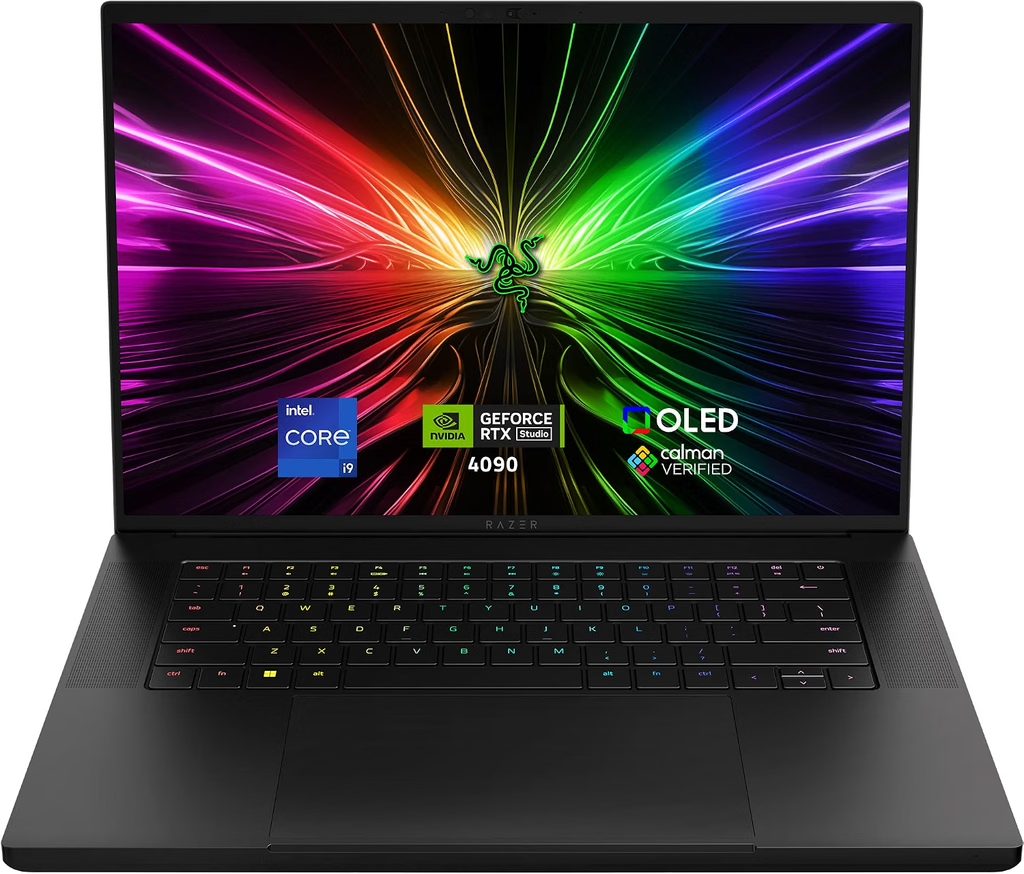
The same caveat applies here. The Blade 16 isn’t an ISV-certified workstation. It is, though, the most portable x86 laptop you can get with a 24GB-VRAM GPU, and that makes it a real option for students, freelancers and engineers who also game or run AI.
Specs:
- CPU: Intel Core Ultra 9 386H (Panther Lake), 16 cores, about 85W short-term / 55W sustained
- GPU: NVIDIA GeForce RTX 5090 Laptop, 24GB GDDR7, 160W (RTX 5080 and RTX 5060 versions also available)
- RAM: 32GB LPDDR5X-9600, soldered
- Storage: 2TB SSD (as tested)
- Display: 16-inch 2560×1600 OLED, 240Hz
- Battery: 90Wh
- Weight: 2.124kg, 17.4mm thick; 861g power adapter
- Ports: 3x USB-A 10Gbps, Thunderbolt 5, Thunderbolt 4, USB4, HDMI, SDXC reader, 3.5mm audio, Wi-Fi 7, Bluetooth 6.0
- Price: $4,900 as tested. Notebookcheck notes that’s $400 more than the 2025 RTX 5090 model’s launch price.
- ISV certification: No (GeForce)
Published benchmarks:
- Cinebench R23: 20,750 multi / 2,087 single (Notebookcheck)
- Geekbench 6: 16,903 multi / 2,886 single (Notebookcheck)
- Display: 465 nits average, 99.7% Display P3, 100% sRGB, Delta E 3.03 (0.6 after calibration), about 1,000 nits in HDR, PWM at 1,441Hz (Notebookcheck)
- Battery: 17 hours 20 minutes of web browsing (Hardware Canucks, as reported by Notebookcheck)
- Rating: 88%, “very good” (Notebookcheck)
Why it’s fifth: Its single-core performance is close to the Dell’s (2,886 vs. 2,907 in Geekbench 6), and the RTX 5090 gives you 24GB of VRAM. But 32GB of soldered RAM is exactly Siemens’ recommended minimum, and you can never add more. You also lose Siemens graphics support.
Pros:
- Very thin and light for a laptop with 24GB of VRAM
- Strong single-core CPU performance
- Gorgeous 240Hz OLED and excellent battery life for its class
- Thunderbolt 5 and plenty of USB-A ports
Cons:
- No ISV certification
- 32GB soldered RAM that can’t be upgraded
- No touchscreen, fingerprint reader or 4K option
- Notebookcheck saw limited sustained turbo performance
- Expensive, even by gaming laptop standards
Who should buy it: Students, hobbyists, and engineers who split time between NX and GPU-heavy AI or gaming and can live without certified support.
Laptops I Left Out on Purpose
- ASUS ProArt P16 (2026, RTX Spark): A well-reviewed creator laptop, but its NVIDIA RTX Spark chip is ARM-based, and Siemens doesn’t support NX on ARM Windows. The older x86 ProArt P16 has been replaced by this model, so it doesn’t count as current.
- Apple MacBook Pro (M5 Pro/Max): Fast, but NX doesn’t run natively on macOS.
- Lenovo ThinkPad P16 Gen 3 (RTX PRO 5000): An excellent NX workstation, and the one to get if you need full HX power in a ThinkPad. I limited this list to one laptop per brand.
- Dell Pro Precision 7 16 (2026): A good middle ground with Panther Lake and up to an RTX PRO 3000 12GB, but the Pro Max 16 Plus took Dell’s slot.
- HP ZBook X G2i: HP’s 2026 16-inch with Panther Lake and up to an RTX PRO 3000. I couldn’t find any independent benchmarks for it yet.
How I Evaluated These Laptops
I’ll be transparent. I didn’t run all five of these $4,000-to-$10,000 machines through my own test bench. I built the rankings from published, independently measured data and weighted it by what NX actually puts load on:
- Siemens compatibility (pass/fail): x86 Windows 11 or certified Linux. ARM and macOS are out, based on Siemens’ own documentation.
- NX viewport (30%): SPECviewperf 15 snx-05 from SPEC.org, plus Notebookcheck’s SPECviewperf 2020 snx-04 where available. Where a model had no snx result, I used the closest stand-in with the same GPU and labeled it clearly.
- Single-core CPU (25%): Geekbench 6 and Cinebench single-core scores from Notebookcheck and StorageReview.
- Memory and storage headroom (20%): Maximum and upgradeable RAM, number of NVMe slots, Gen5 support.
- Certification and support (15%): ISV status and driver branch.
- Portability, battery, display and thermals (10%): Measured brightness, color accuracy, battery tests and thermal behavior.
Checking for newer models: I checked every pick against 2026 launches, including Dell’s March 2026 workstation refresh, Lenovo’s P1 Gen 9, HP’s 2026 ZBook updates, Intel’s Core Ultra 200HX Plus chips, Razer’s 2026 Blade 16 and MSI’s Computex 2026 lineup. None of the five has been replaced by a newer generation.
Limits: These benchmarks come from different labs and different configurations, so I compare numbers from the same test wherever possible. Battery tests in particular use different methods: the HP figure comes from an HP-commissioned report, and I’ve labeled it that way. Prices change constantly, so treat them as snapshots from when each laptop was reviewed.
NX Buyer’s Checklist: Licensing, OS and Driver Pitfalls
- Look up your exact laptop model and GPU in the Siemens NX Graphics Certification Table before you buy.
- Match the OS to your NX version: Windows 11 is fully supported for the June 2026 release; Windows 10 has only limited support.
- Install the Siemens-certified NVIDIA workstation driver, not the latest Game Ready driver.
- Make sure it’s x86: no Snapdragon, no RTX Spark, no Apple Silicon.
- On Linux, check the distro version: RedHat/Rocky 8.10 and SuSE 15 are listed as supported for the June 2026 release.
- Choose upgradeable RAM (CAMM2, LPCAMM2 or SODIMM) and start with at least 32GB.
- Put your NX data on a separate NVMe drive if the laptop has two or more slots.
- Match the GPU to your resolution: an RTX PRO 2000 or 3000 is enough for 1080p–1600p; aim for an RTX PRO 5000 at 4K.
- Check your license type (node-locked or floating) with your reseller before moving to a new machine, since a new laptop can require an updated license file.
- Check the warranty: HP’s 18-inch Fury comes with one year from HP.com, while Dell’s Pro Max 16 Plus includes three years of onsite service.
Frequently Asked Questions
What is the best laptop for Siemens NX in 2026?
The Dell Pro Max 16 Plus with the RTX PRO 5000 Blackwell. It has the highest published laptop score in SPECviewperf 15’s Siemens NX viewset (109.24 at 1080p and 95.86 at 4K) and it’s ISV-certified.
How much RAM do I need for Siemens NX?
Siemens lists 8GB as the minimum and recommends 32GB or more, ideally as much as the machine can hold. For large assemblies or Simcenter work, start at 64GB and pick a laptop you can upgrade.
Can I run Siemens NX on a MacBook?
Not natively. NX/Designcenter runs on Windows and Linux, not macOS, and Apple Silicon is ARM-based, which Siemens doesn’t support.
Can I run Siemens NX on a Snapdragon or RTX Spark laptop?
No. Siemens says NX/Designcenter isn’t supported on ARM-based Windows, and tools such as Measure don’t work correctly there.
Do I need an RTX PRO GPU, or will a GeForce RTX 5090 work?
A GeForce card works, but it isn’t certified, so Siemens can decline graphics and performance issues that don’t reproduce on certified hardware. For professional work, RTX PRO is the safer choice.
Which matters more for NX, the CPU or the GPU?
Both, for different tasks. Modeling and rebuilds depend on single-core CPU speed. Viewport smoothness in big assemblies depends on the GPU, especially at 4K. Simcenter solves depend on core count and RAM.
What’s the newest version of NX?
The June 2026 release, version 2606, now sold under the Designcenter name.
Is the ThinkPad P1 Gen 9’s RTX PRO 2000 enough for NX?
For modeling, drafting and mid-sized assemblies at 1080p to 1600p, yes. In snx-05 at 1080p, an RTX PRO 2000 laptop scored 100.94, compared with 109.24 for the RTX PRO 5000. For 4K or very large assemblies, step up to a bigger GPU.
Final Verdict
If NX is how you make a living and your laptop mostly sits on a desk, get the Dell Pro Max 16 Plus with as much RAM and GPU as your budget allows. It’s the fastest certified NX laptop with published results to back it up. If you travel, the Lenovo ThinkPad P1 Gen 9 is the better buy for most engineers: it’s certified, works well on Linux, is light, and its battery lasts far longer than any workstation I’d have expected. Choose the HP ZBook Fury G1i 18 when screen size and expandability matter more than weight. Only go with a GeForce laptop, the MSI Raider 16 Max HX for the fastest modeling feel or the Razer Blade 16 for the thinnest chassis, if you accept that you’re giving up Siemens graphics support in return.
Whichever one you choose, check the exact model in Siemens’ graphics certification table before you pay. It takes five minutes and can save you months of viewport problems.
Sources
- SPEC: SPECviewperf 15 Results Overview
- SPEC: Dell Pro Max 16 Plus SPECviewperf 15 Result
- Siemens: Designcenter Buyer’s Guide and System Requirements
- Siemens Support: Does NX or Designcenter Run on ARM-Based Windows Platforms?
- Siemens Community: NX Features on ARM-Based Windows
- NX 2506 Release Notes
- Engineering Software Trials: NX CAD Latest Version, June 2026
- Notebookcheck: Dell Pro Max 16 Plus Review
- StorageReview: Dell Pro Max 16 Plus Review
- Trusted Reviews: Dell Pro Max 16 Plus Review
- IT Pro: Dell Pro Max 16 Plus Review
- Dell: Pro Max 16 Plus Product Page
- Notebookcheck: Lenovo ThinkPad P1 Gen 9 Review
- StorageReview: Lenovo ThinkPad P1 Gen 9 Review
- Notebookcheck: Lenovo Updates ThinkPad P1 with Gen 9
- Notebookcheck: HP ZBook Fury G1i 18 Review
- Notebookcheck: HP ZBook Fury G1i 18 vs. Dell Pro Max 18 Plus Benchmarks
- StorageReview: HP ZBook Fury G1i 18 Review
- Principled Technologies: HP ZBook Fury G1i 18 Battery and Performance Report
- Notebookcheck: HP ZBook Fury G1i 16 Refresh with HX Plus and 192GB RAM
- Notebookcheck: MSI Raider 16 Max HX Review
- Tom’s Hardware: MSI Raider 16 Max HX Review
- MSI: Computex 2026 Lineup
- Notebookcheck: Razer Blade 16 (2026) Review
- Notebookcheck: Razer Blade 16 2026 vs. 2025
- Notebookcheck: NVIDIA RTX PRO 5000 Blackwell Laptop GPU
- StorageReview: Dell Pro Precision 7 16 Review
- StorageReview: Lenovo ThinkPad P16 Gen 3 Review
- Trusted Reviews: ASUS ProArt P16 (2026, RTX Spark) Review
- HP: ZBook X G2i

Hi, my name is Burak. I am a mechanical engineer. I have been writing laptop reviews for the Engineering Laptops website since 2020. Please feel free to contact me if you have any questions.