Estimated reading time: 1 minute
Table of contents
- The quick version
- What Enscape actually wants from a laptop
- It renders on the GPU, and it needs dedicated VRAM
- Nvidia isn’t just “preferred” — AMD actually loses features
- The CPU doesn’t draw your frames, but it decides how long you stare at a loading bar
- Windows on Arm is a trap right now, including the shiny new ProArt
- If you’re on a Mac, know exactly what you’re getting
- The small stuff that catches people out
- How I approached this, and where every number comes from
- The measurement that rearranged my whole list
- The five best laptops for Enscape in 2026
- 1. Dell Pro Max 16 Plus — the one I’d buy if the practice is paying
- 2. MSI Raider 16 Max HX — the most Enscape performance per pound
- 3. Razer Blade 16 (2026) — the one you’ll actually carry
- 4. ASUS ProArt P16 (H7606WX) — the best screen for showing clients
- 5. Lenovo ThinkPad P16 Gen 3 — the sensible long-term choice
- Head to head
- How much VRAM do you actually need?
- Getting the most out of Enscape once the laptop arrives
- What I’d avoid buying in 2026
- Should you wait?
- Frequently asked questions
- The verdict
I’ve watched it happen more times than I’d like. An architect opens the Revit model, clicks the Enscape button in front of a client, and then spends the next ninety seconds apologising while the fans howl and the walkthrough crawls along at fourteen frames a second. Three weeks of work on that facade, and the laptop makes it look like a video game from 2004.
That’s why I put this together.
I’m not going to hand you a list of gaming laptops ranked by the biggest number on the box. That approach is wrong more often than it’s right, and I’ll show you exactly why with real measurements. There’s now a proper, vendor-neutral Enscape benchmark that professional testing labs actually run, and once you see those numbers, the whole “just buy an RTX 5090” idea falls apart in a hurry.
Fair warning, this is a long one. Make a coffee.
The quick version
| If this is you | Get this | Why | Rough price |
|---|---|---|---|
| Architect in a firm, big federated models, IT has a say | Dell Pro Max 16 Plus (RTX Pro 5000, 24 GB) | Highest measured Enscape score of any 16-inch laptop, certified drivers, 128 GB CAMM2 | From $2,779; ~$5,000 well-specced |
| You want the most Enscape performance per pound spent | MSI Raider 16 Max HX (RTX 5090, 175 W) | Full-power GPU, coolest thermals I’ve seen data on, 8.5 hours of battery | $2,999 base / ~$4,299 with the 5090 |
| Site visits, client offices, trains, hotel desks | Razer Blade 16 (2026) | 12 hours 46 minutes measured, 2.14 kg, still a 175 W RTX 5090 | $3,499–$4,899 |
| Your deliverable is the image, and colour has to be right | ASUS ProArt P16 (H7606WX) | ΔE 0.5 factory-accurate 4K tandem OLED, 24 GB VRAM, 1.95 kg | $3,999 MSRP |
| Buying for a studio, or your models are enormous | Lenovo ThinkPad P16 Gen 3 | Up to 192 GB replaceable RAM, 24 GB pro GPU, 7 hours unplugged | From $3,527 |
Now let me explain how I got there.
What Enscape actually wants from a laptop
Most buying guides treat Enscape like a game. It isn’t. It’s a real-time ray tracer bolted onto a BIM application, and it has a very specific personality. Once you understand that personality, picking hardware stops being guesswork.
It renders on the GPU, and it needs dedicated VRAM
Chaos says this plainly in their own documentation: Enscape renders using your graphics card, and that card needs dedicated VRAM, not the shared memory that Intel integrated graphics uses. Below 4 GB you can technically launch it but you won’t render anything real. Their recommendation for professional work is 8 GB or more, and 12 GB if you’re doing VR. Their general advice boils down to buying as much VRAM as your budget allows, because geometry, textures, render resolution and quality settings each take a bite out of it.
This is the most important sentence in the whole article. Every machine below has at least 12 GB and four of the five have 24 GB. For a mid-size hotel or a hospital model, that is not overkill.
Nvidia isn’t just “preferred” — AMD actually loses features
Here’s something almost nobody mentions, because you have to dig through changelogs to find it. In the Enscape 4.14.0 release notes, Chaos recorded that Ray Traced Artificial Lights was disabled on AMD GPUs due to driver-related visual artefacts. Not deprioritised. Switched off.
On top of that, Enscape’s DLSS support — including the jump to DLSS 4 Super Resolution with optimised presets — is Windows-and-Nvidia only. And DLSS in Enscape isn’t a gaming novelty. It renders the scene at a lower internal resolution and reconstructs it, which is exactly what rescues you when you’re pushing a 4K panel through a heavy interior with ReSTIR lighting turned on.
So, buy Nvidia. I’m not saying that out of brand loyalty. I’m saying it because the software vendor’s own release notes say AMD users get fewer features.
The CPU doesn’t draw your frames, but it decides how long you stare at a loading bar
Chaos puts it simply: a good CPU speeds up Enscape’s loading times. Frame rate in the viewport is GPU work. But getting to the viewport — Revit chewing through the model, the geometry handoff, the initial upload into VRAM — leans hard on the processor. On a big federated model that’s the difference between thirty seconds and three minutes, every time you open the project.
Hold onto that thought. It’s the one place the Razer Blade 16 (2026) genuinely stumbles, and I’ll come back to it.
Windows on Arm is a trap right now, including the shiny new ProArt
This is the finding I most want you to walk away with.
At Computex 2026, ASUS announced a new ProArt P16 (H7607) built around Nvidia’s Arm-based RTX Spark superchip: a 20-core Grace CPU, a Blackwell RTX GPU with 6,144 CUDA cores, up to 128 GB of unified memory, 1.77 kg, arriving in the second half of 2026. It looks spectacular. Half the internet has already crowned it creator laptop of the year.
Now go and read Chaos’s system requirements page: Windows 11 ARM is not officially supported and has not been tested. Issues may occur.
That’s the whole warning, and it’s why I wouldn’t put a deposit on an RTX Spark ProArt as an Enscape machine today. Maybe Chaos ships Arm support. Maybe emulation turns out fine. But “issues may occur” is not a phrase I want sitting between me and a client presentation. If Enscape pays your bills, buy x86 in 2026 and revisit Arm when that documentation changes.
If you’re on a Mac, know exactly what you’re getting
Enscape for Mac exists, but it’s Apple Silicon only. Intel Macs aren’t supported at all, not natively and not through Boot Camp or Parallels. More importantly for architects, the Mac plug-in covers SketchUp, Rhino and Vectorworks. Revit isn’t on that list, because Revit doesn’t run on macOS at all. If your practice is Revit-based, a MacBook Pro isn’t the answer no matter how good the M-series chip has got.
The small stuff that catches people out
- Chaos recommends a wired connection over Wi-Fi, because the Chaos Cosmos asset library loads slowly over flaky wireless. Look for an RJ45 port, or budget for a dock.
- Enscape needs Vulkan 1.1 support as a floor.
- A second monitor is more or less assumed in the workflow, with CAD on one screen and Enscape on the other. Port selection matters more than most people expect.
- Enscape 4.18.1, released in May 2026, added Revit 2027 support, so version alignment is healthy right now.
How I approached this, and where every number comes from
I want to be straight with you, because there’s a lot of “hands-on testing” online that is neither hands-on nor testing.
What I bring: years of running Enscape on laptops in real project conditions — site huts, client boardrooms, coworking desks, aeroplane tray tables. The workflow observations, the setup traps, the “here’s what actually goes wrong on a Tuesday afternoon” parts of this article come from that.
What the labs bring: every hard figure below was measured by a named third-party lab with a repeatable method, and I credit it inline every single time. Nothing here is estimated, guessed from a spec sheet, or invented. The labs I’m drawing on are StorageReview, Notebookcheck, Tom’s Hardware, Ultrabookreview, ServeTheHome, PCWorld, PC Gamer, TechRadar, TrustedReviews, IT Pro and 91mobiles.
The tests that actually matter for Enscape
SPECviewperf 15 — enscape-01. This is the one that changes everything. SPEC’s benchmark suite added a Vulkan workload built directly from Chaos Enscape 4.0, exercising GPU-accelerated ray tracing in an architectural visualisation scene. It runs without an Enscape licence installed, which is why labs can publish it. If you only look at one number when buying an Enscape laptop, look at this one. Not Time Spy. Not Cyberpunk frame rates.
Sustained thermals. Enscape sessions aren’t ninety-second benchmark runs, they’re forty-minute design reviews. What matters is the clock speed in minute thirty-five, the temperature of the palm rest, and how loud the fans get in a quiet meeting room.
Battery under real load. Not “video playback with the screen dimmed to nothing.” Mixed, realistic workloads.
Display measurement. If you’re choosing a limestone finish on this screen, ΔE isn’t a spec-sheet vanity metric. It’s whether the material looks right when it’s built.
SSD throughput. Big Revit central files, linked models, Cosmos assets, exported standalones. Sequential read is the number you feel.
Cinebench and Geekbench. Proxies for the CPU work that sets your load times.
The measurement that rearranged my whole list
Here’s what happens when you stop reading GPU names and start reading power limits.
StorageReview has now tested four mobile workstations that all carry the exact same GPU — the Nvidia RTX Pro 5000 Blackwell with 24 GB of GDDR7. Identical silicon, identical VRAM, identical drivers. The only meaningful difference is how many watts each manufacturer lets it pull.
| Machine | RTX Pro 5000 power ceiling | enscape-01 score | Gap vs. best |
|---|---|---|---|
| Dell Pro Max 18 Plus | 175 W | 86.70 | — |
| Dell Pro Max 16 Plus | 175 W | 84.84 | −2.1% |
| HP ZBook Fury G1i | 150 W | 77.57 | −10.5% |
| Lenovo ThinkPad P16 Gen 3 | 105 W | 68.15 | −21.4% |
All four measured by StorageReview using SPECviewperf 15.
Read that again. A 27% swing in Enscape performance between the fastest and slowest, from a GPU with the same name on the box.
It isn’t a quirk of one viewset either. The same pattern runs right through the suite. In unreal_engine-01 the spread is 69.74 to 93.46. In 3dsmax-08 it’s 82.16 to 98.71. Notebookcheck reached the same conclusion independently when they tested the ThinkPad P16 Gen 3, measuring it around 24% behind the Dell across both professional and consumer graphics testing, and pinning it squarely on Lenovo capping the GPU and shipping a 180 W USB-C charger instead of a proper brick.
So when someone tells you to just get the RTX 5090 because it’s the fastest, the honest answer is that an RTX 5090 at 120 W in a slim chassis and an RTX 5090 at 175 W in a thick one are two different products wearing the same badge. Always find the TGP before you buy. It’s usually hidden in a footnote, and it matters more than almost anything else on the page.
One more thing worth knowing before you plan a client demo. Notebookcheck measured the ThinkPad P16 Gen 3 scoring 37,978 in the 3DMark 11 GPU test on battery, a 23% drop from its plugged-in result, and its Cinebench R23 multi-core result fell 26% to 27,728 points on battery too. That pattern holds broadly across the category. Find a socket, or rehearse at the lower frame rate.
The five best laptops for Enscape in 2026
1. Dell Pro Max 16 Plus — the one I’d buy if the practice is paying
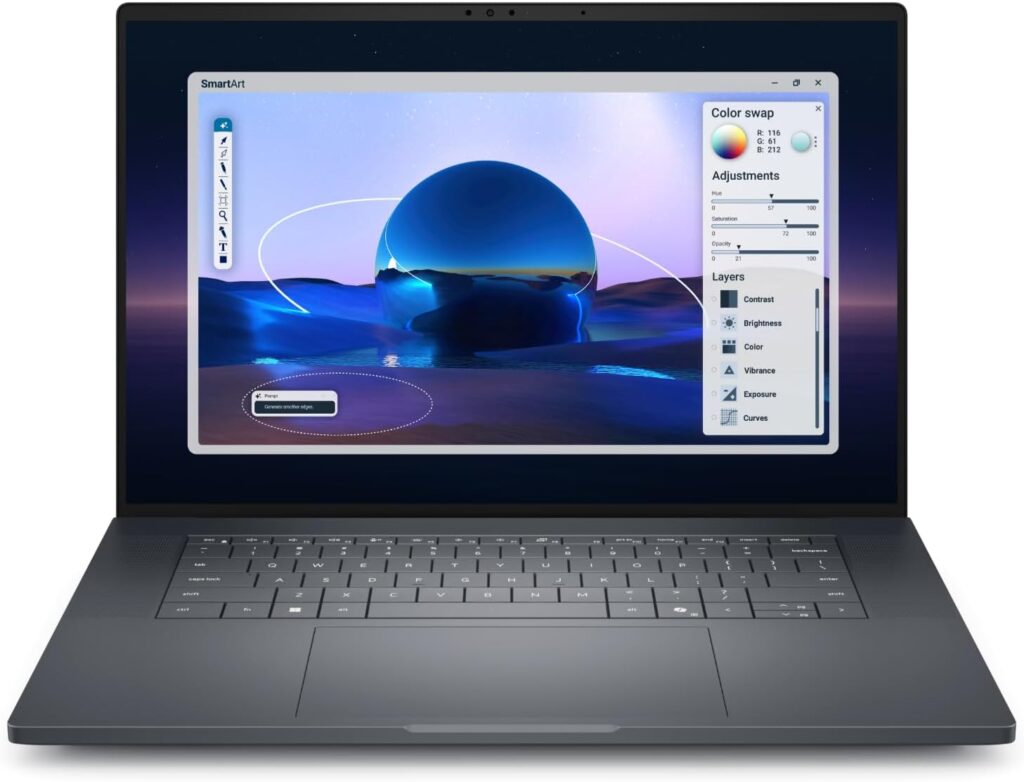
This is the machine for architects who treat Enscape as a deliverable rather than a party trick. It’s heavy, it’s expensive, it gets warm, and it posts the highest measured Enscape score of any 16-inch laptop I’ve found data for.
What’s inside
- CPU: Intel Core Ultra 9 285HX, 24 cores (8 P-cores to 5.5 GHz, 16 E-cores to 4.6 GHz). Notebookcheck logged it at 159 W PL2 short-burst and 90 W PL1 sustained
- GPU: Nvidia RTX Pro 5000 Blackwell, 24 GB GDDR7, configured at a 175 W TDP in StorageReview’s test unit
- RAM: Up to 128 GB DDR5-6400 on Dell’s CAMM2 module — replaceable, not soldered
- Storage: Three M.2 Gen5 slots, up to 4 TB each, with RAID 0/1/5 available
- Display: 16-inch 3840 × 2400 tandem OLED touchscreen, 120 Hz VRR, 500 nits, 100% DCI-P3, VESA True Black 1000. Lower-cost 1920 × 1200 panels are also offered
- Ports: 2× Thunderbolt 5, 1× Thunderbolt 4, HDMI 2.1, 2.5 Gbps Ethernet, SD reader, optional Smart Card, 2× USB-A
- Certification: Over 100 ISV certifications, MIL-STD-810H, three-year next-business-day warranty as standard
- Battery / power: 96 Wh, 165 W or 280 W adapter
- Weight: From 5.63 lb (2.55 kg); Notebookcheck weighed a loaded unit at 2.85 kg
- Price: From $2,779 per StorageReview. Notebookcheck quoted roughly $5,000 for a Core Ultra 9 / RTX Pro 5000 / 128 GB / 2 TB build; StorageReview’s maxed-out dual-4 TB RAID 0 review unit listed at about $8,900
Enscape performance. StorageReview measured 84.84 in enscape-01, within 2% of the 18-inch Pro Max 18 Plus and comfortably ahead of the HP ZBook Fury G1i’s 77.57. It also took 20,978 in Geekbench 6 multi-core and 3,032 single-core, plus 245,286 in the Geekbench OpenCL GPU test — the highest of the three workstations they compared. In V-Ray it scored 7,804, and in Blender’s GPU Classroom scene it managed 2,000.89 samples per minute.
Thermals and noise. StorageReview described the three-fan cooling as keeping temperatures in check with audible airflow but no droning. IT Pro measured the fans at around 43 dB from half a metre away at full tilt, and noted a faint high-pitched whine with small spikes around 15 and 20 kHz that younger ears may find intrusive. 91mobiles observed CPU temperatures climbing into the mid-to-high 90s °C under sustained stress and occasionally touching triple digits, which is where the sustained power settles rather than keeps scaling.
Battery. Here’s where the labs disagree, and I’d rather show you that than pretend otherwise. StorageReview recorded 6 hours 21 minutes in the PCMark 10 Modern Office battery test — double what the 18-inch sibling managed at 3 hours 39 minutes. TrustedReviews, testing a differently configured unit with the 4K OLED pinned at 150 nits, got 2 hours 37 minutes. 91mobiles landed between the two at four to six hours in a PCMark 10 video loop at 80% brightness. My reading: the 4K OLED and the workload swing this enormously, and you should plan around the lower end if you’re driving the panel hard.
Charging is slow either way. TrustedReviews recorded 45 minutes to reach 50% and 100 minutes for a full charge from the 280 W brick.
Display. The 4K tandem OLED is the reason to spec the top model. ServeTheHome confirmed the 500-nit rating, full DCI-P3 coverage and VESA True Black 1000 certification, and it’s the only touch panel Dell offers on this chassis. TrustedReviews found 100% sRGB coverage and called colour accuracy excellent. It isn’t as bright as the ProArt’s panel, but for reviewing renders and picking finishes it’s more than good enough.
Storage. StorageReview’s Blackmagic Disk Speed Test returned 7,755.6 MB/s read and 5,734.7 MB/s write. Loading a 900 MB central model off that is not going to be your bottleneck.
Pros
- Highest measured
enscape-01score of any 16-inch machine here, at 84.84 - 24 GB VRAM plus up to 128 GB of replaceable CAMM2 system RAM
- Superb 4K 120 Hz tandem OLED with True Black 1000
- Port selection is close to a dock on its own, including 2.5 GbE and dual Thunderbolt 5
- Modular DGFF graphics card and CAMM2 memory, which matters across a five-year fleet cycle
- Three-year next-business-day warranty as standard, and over 100 ISV certifications
Cons
- 2.85 kg as configured, plus a 280 W brick, is a heavy bag
- Battery results swing wildly by configuration and workload, and the worst case is poor
- CPU temperatures reach the mid-to-high 90s °C under sustained load
- Notebookcheck noted no ECC RAM option and short-lived maximum Turbo Boost
- The keyboard layout is divisive — Home and End share the F11/F12 keys, and there are no dedicated Page Up/Down keys
- Pricing climbs frighteningly fast once you tick the good options
Who it’s for. Firms. If someone else signs the invoice and your models are federated and enormous, this is the machine. Freelancers paying out of pocket, keep reading.
2. MSI Raider 16 Max HX — the most Enscape performance per pound
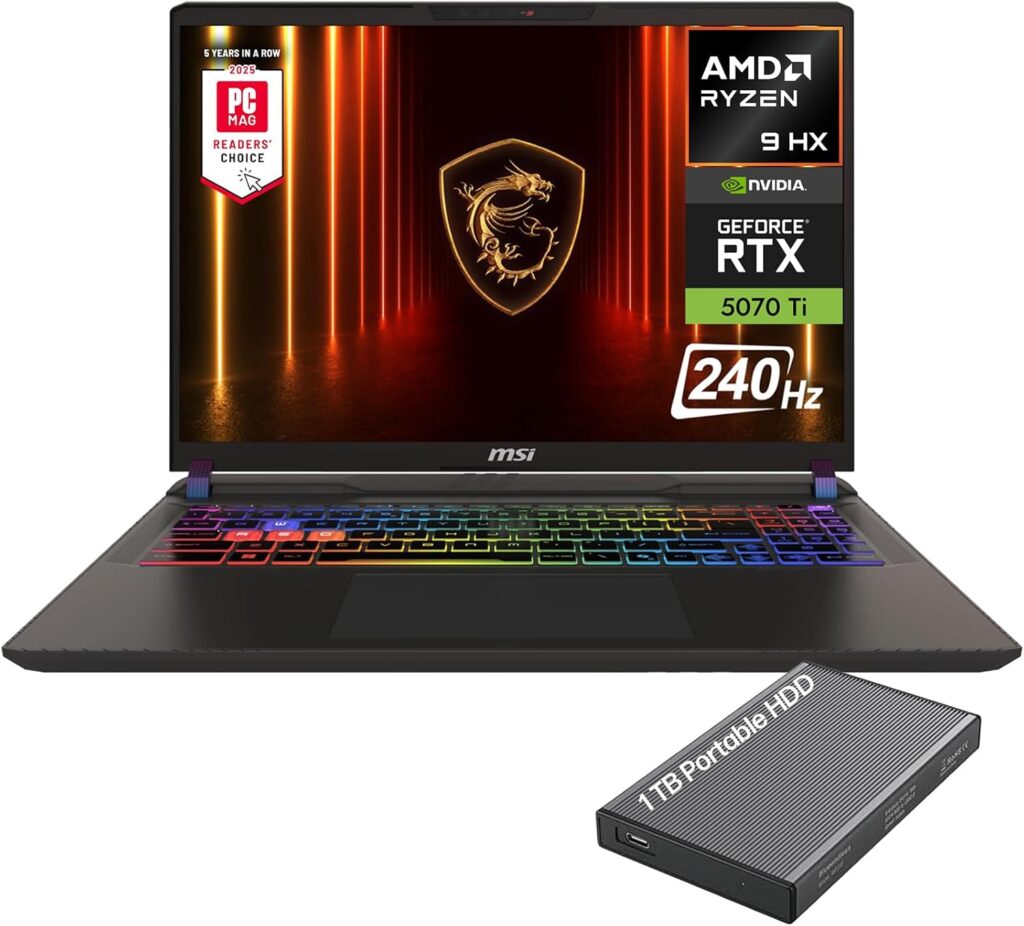
The Raider surprised me. On paper it’s a gaming laptop with silly branding. In practice, Tom’s Hardware measured thermals and battery life that embarrass machines twice as sensible-looking, and it gives you a full-power RTX 5090 for meaningfully less money than a certified workstation.
What’s inside
- CPU: Intel Core Ultra 9 290HX Plus, 24 cores — the 2026 refresh of the 285HX with higher base and E-core clocks
- GPU: Nvidia GeForce RTX 5090 Laptop, 24 GB GDDR7, at the full 175 W TGP
- Display: 16-inch 2560 × 1600 OLED, 240 Hz, VESA DisplayHDR True Black 1000
- Battery: 99.9 Wh, with a 400 W adapter
- Ports: 2× Thunderbolt 4, 3× USB-A, HDMI 2.1, SD reader, 3.5 mm, 2.5 GbE Ethernet
- Weight: 2.6 kg (5.73 lb per Tom’s Hardware), 21.95 mm at its thinnest
- Price: From $2,999; the RTX 5090 configuration lands around $4,299 per TechRadar
Enscape performance. No published enscape-01 score yet, so let me be clear about what I can and can’t tell you. What I can tell you is that Notebookcheck’s GPU database confirms the RTX 5090 Laptop uses the GB203 chip with 10,496 CUDA cores, 24 GB of GDDR7 and 896 GB/s of bandwidth — the same shader count and memory bandwidth as the RTX Pro 5000 sitting in the Dell. Run it at the same 175 W and you’re in the same performance neighbourhood. The difference is drivers, not silicon.
That driver difference is real but frequently overstated for Enscape specifically. Enscape is a Vulkan real-time renderer, not a CAD viewport application. It doesn’t lean on the certified OpenGL paths that make pro cards worth paying for in SolidWorks or CATIA. Revit’s own viewport is a different story — if you live in Revit and only visit Enscape occasionally, the certified card earns its keep. If Enscape is where you spend your day, the GeForce card is the better buy.
For raw numbers: Tom’s Hardware recorded 3,231 single-core and 20,656 multi-core in Geekbench 6, and TechRadar measured Cinebench R24 at 2,229 multi / 134 single, 3DMark Steel Nomad at 6,203 and Speed Way at 6,254. Tom’s Handbrake 4K-to-1080p transcode finished in 1 minute 51 seconds, the fastest in their group.
Thermals. This is where the Raider shines, and it’s why it’s on this list. During Tom’s Hardware’s fifteen-loop Metro Exodus stress test they measured the CPU at 75 °C and the RTX 5090 at 72 °C. For a 175 W GPU under sustained load, those are outstanding numbers. Surface temperatures came in at 87 °F (about 31 °C) between the G and H keys, 74 °F (23 °C) on the touchpad, and 109 °F (43 °C) on the underside near the exhausts. Tom’s also reported that fan noise is well-controlled, to the point where the speakers overpower it during gaming.
For contrast, Matthew Moniz tested the same 290HX Plus chip in other chassis and found sustained loads pushing it to 100–103 °C and throttling. Same processor, wildly different result. Chassis engineering is not a detail.
Battery. Tom’s Hardware measured 8 hours 34 minutes in their mixed web-browsing, OpenGL and video-streaming test at 150 nits — more than two hours ahead of the ASUS in their comparison group and miles clear of the Alienware’s 3 hours 33 minutes. PCWorld corroborated it with a little over eight hours in their offline video playback test, noting the Raider is aggressive about shutting off the discrete GPU on battery.
Display. Notebookcheck measured this panel with an X-Rite i1Pro 3 and got 487.2 nits maximum, 98% brightness uniformity, ΔE ColorChecker of 0.62 and ΔE greyscale of 0.7, with 99.9% sRGB, 99.3% Display P3 and 87.5% AdobeRGB coverage, gamma 2.16 and a colour temperature of 6,535 K. Tom’s separately measured 456 nits peak and 991 nits on a 40% HDR window. PCWorld found a maximum dE1976 of 1.74 and called it safe for creative colour work.
That’s a genuinely excellent panel on a machine most people would dismiss as a gaming laptop. The catches: it’s very glossy, and there’s no G-Sync or VRR on the internal display.
Storage. TechRadar’s Blackmagic Disk Speed Test returned 4,790 MB/s read and 3,314 MB/s write. Respectable, but well behind the Gen5 workstation drives. Tom’s 25 GB file transfer test was the weak spot at 1,357.93 MB/s, against 2,738.9 MB/s for the Alienware in the same group.
The honest caveat. PCWorld’s verdict was cooler than mine. They found the RTX 5090’s advantage over cheaper hardware only really opened up with ray tracing enabled, at roughly 10 to 20%, and concluded the extra money doesn’t always buy proportionate performance. For gaming, that’s fair. For Enscape, ray tracing is the workload, so that 10–20% is precisely the number you care about.
Pros
- Full 175 W RTX 5090 with 24 GB of VRAM at a far friendlier price than the pro-GPU machines
- Best measured thermals here by a distance, at 75 °C CPU and 72 °C GPU under sustained load
- 8 hours 34 minutes of battery from a 300 W-class system is genuinely unexpected
- Excellent OLED panel with a measured ΔE of 0.62 — good enough for colour work
- Built-in 2.5 GbE, which matters given Chaos’s own advice about wired connections and the asset library
- Fastest Handbrake result in Tom’s group, at 1:51
Cons
- Consumer GeForce drivers with no ISV certification — if your IT department has a policy, this fails it
- TechRadar found the build quality wanting for the price, and most of the chassis is plastic
- No G-Sync or VRR on the internal panel, and the glossy finish fights glare
- Storage is the slowest of the flagship configs here, and Tom’s called out the file transfer result specifically
- PCWorld found the keycaps poorly stabilised and lacking contour
- 2.6 kg plus a 400 W brick that weighs nearly three pounds on its own
- It looks like a gaming laptop, because it is one
Who it’s for. Freelancers, small studios, and anyone whose budget is real money. Best value in the article.
3. Razer Blade 16 (2026) — the one you’ll actually carry
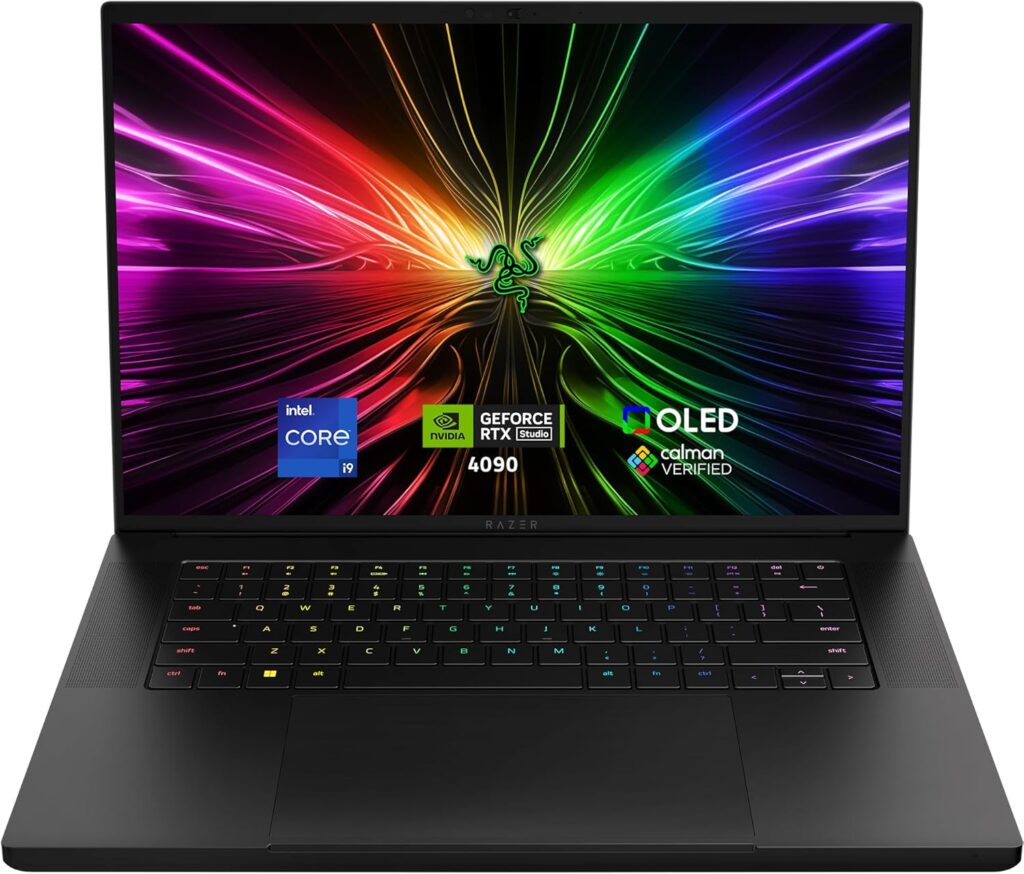
If your week involves site visits, client offices, trains and hotel desks, this changes the maths completely. Razer dropped Intel’s Panther Lake silicon into the same excellent 0.69-inch chassis and produced a battery result I had to read twice.
What’s inside
- CPU: Intel Core Ultra 9 386H, 16 cores (4 Performance, 8 Efficient, 4 Low-Power Efficient), 4.9 GHz max boost. Tom’s Hardware measured it configured at just 25 W; PC Gamer notes an 80 W maximum boosted draw
- GPU: Nvidia GeForce RTX 5090 Laptop, 24 GB GDDR7, 175 W max TGP, 1,597 MHz boost clock
- RAM: 32 GB LPDDR5X-9600 — soldered, no upgrade path
- Storage: 2 TB Lexar NM790 PCIe 4.0, in one of two M.2 2280 slots. The second ships empty
- Display: 16-inch 2560 × 1600 OLED, 240 Hz
- Ports: 1× Thunderbolt 5, 1× Thunderbolt 4, 3× USB-A, HDMI 2.1, SD (UHS-II)
- Battery: 90 Wh, 280 W adapter
- Weight: 2.14 kg (4.71 lb), 0.69 inches thick
- Price: $4,899.99 as tested. $3,999.99 with an RTX 5080, $3,499.99 with an RTX 5070 Ti
Battery, the headline. Tom’s Hardware recorded 12 hours 46 minutes in their mixed-workload battery test at 150 nits. That beat the previous AMD-powered Blade 16 by over five hours and the Alienware 16 Area-51 by more than nine. For a 16-inch laptop carrying a 175 W RTX 5090, that borders on absurd. It’s the Panther Lake efficiency story landing exactly as promised.
In practice it means you can do a full day of modelling, email and coordination unplugged, then plug in when it’s time to render. That’s a real change to how you work, not a spec-sheet trophy.
Thermals. During the Metro Exodus stress test Tom’s measured the CPU at 75.3 °C and the RTX 5090 at 87 °C. Surface temperatures were 102 °F (39 °C) between the G and H keys, 92 °F (33 °C) on the touchpad, and 130 °F (54 °C) at the rear centre of the underside. Keep it on a desk, not your knees. And be warned: Tom’s described the fans as incredibly loud under load, which in a quiet meeting room is not a small problem.
The catch, and it’s Enscape-shaped. That 25 W CPU configuration hurts multi-threaded performance badly. Geekbench 6 put the Blade at 2,895 single-core and 16,971 multi-core. Respectable single-core, but the 290HX Plus machines in Tom’s comparison set hit 3,231 and 20,656. In Handbrake, the Blade took 3 minutes 17 seconds against the Raider’s 1 minute 51.
Remember what Chaos says about the CPU driving load times. That roughly 20% multi-core deficit is a Revit open-and-sync tax you pay every single day. The viewport frames will be fine, because that’s the 175 W GPU’s job. The waiting will be worse.
The gaming results tell the same story. Tom’s found the 2026 model actually fell behind its 2025 predecessor at 1600p in several titles — 133 fps versus 162 in Shadow of the Tomb Raider, and 71 versus 94 in Red Dead Redemption 2 — because the 25 W CPU can’t keep up with the 28 W Ryzen it replaced.
Display. Tom’s measured 408.2 nits, with 90% DCI-P3 and 127% sRGB colour volume. Razer rates the 2026 panels at up to 500 nits SDR and 1,100 nits HDR. Tom’s noted some regression against last year’s Blade in both colour spaces, but called the panel excellent in isolation.
Storage. Tom’s 25 GB file transfer test returned 1,735.09 MB/s, second in their group but a full 1,000 MB/s behind the leader. A PCIe 4.0 drive in a $4,900 laptop is stingy. The empty second M.2 slot is your fix.
Pros
- 12 hours 46 minutes of measured battery, which nothing else with a 175 W RTX 5090 comes close to
- 2.14 kg and 0.69 inches — you’ll actually take it to the site meeting
- Build quality and design remain the best in the category
- Very good OLED panel, plus Thunderbolt 5 for single-cable desk docking
- Two M.2 slots with one free from the factory
- The RTX 5080 configuration at $3,999.99 is arguably the smarter buy
Cons
- Multi-threaded CPU performance lags badly, and that’s your model load times
- Some 1600p gaming results actually regressed versus the 2025 model, for the same reason
- RAM is soldered at 32 GB. That’s it, forever
- Very loud fans under sustained load
- PCIe 4.0 primary SSD at this price
- No haptic trackpad, which Tom’s flagged as odd for $4,900
- No Ethernet port, which is awkward given Chaos’s advice about the asset library
- $4,899.99 is a great deal of money
Who it’s for. Architects who travel. If your laptop lives on a desk, buy the Raider and pocket the difference.
4. ASUS ProArt P16 (H7606WX) — the best screen for showing clients
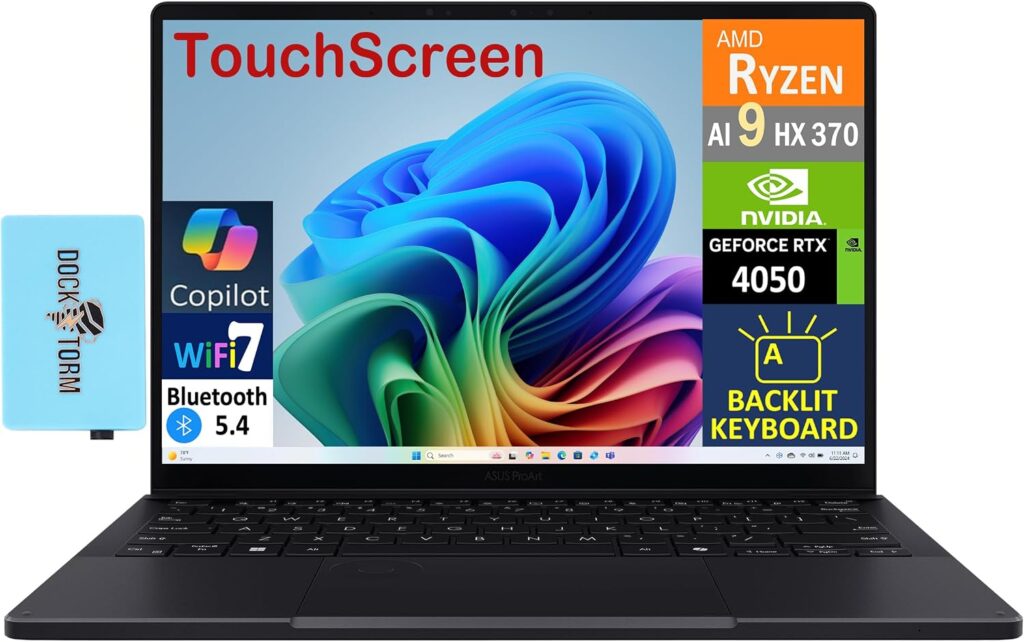
Notebookcheck rated this 90% and called it the best Windows laptop for creators. For Enscape work specifically, the appeal is the panel: the most colour-accurate display in this roundup, in a 1.95 kg chassis, with 24 GB of VRAM behind it.
What’s inside
- CPU: AMD Ryzen AI 9 HX 370, 12 cores / 24 threads (4× Zen 5 to 5.1 GHz, 8× Zen 5c), 80 W sustained
- GPU: Nvidia GeForce RTX 5090 Laptop, 24 GB GDDR7 at 120 W including 25 W Dynamic Boost
- RAM: 64 GB LPDDR5X-7500 — soldered
- Storage: 2× 2 TB Micron 2500. Note the second slot runs at PCIe 4.0 x2, which halves its bandwidth
- Display: 16-inch 3840 × 2400 Lumina Pro tandem OLED, 120 Hz VRR, touch with pen support
- Ports: USB4, 3× USB-A 3.2, second USB-C with DisplayPort and Power Delivery, HDMI 2.1, SD Express 7.0, 3.5 mm. No Ethernet
- Battery: 90 Wh, 240 W adapter, USB-C charging up to 100 W
- Weight: 1.952 kg, 18.3 mm
- Price: $3,999 MSRP per both Notebookcheck and Ultrabookreview. Street pricing has run considerably higher — NoobFeed cited $5,499 and TechRadar around $5,800 — and availability has been patchy
Display measurements, the reason to buy it. Notebookcheck’s X-Rite i1Pro 3 numbers are the best in this article, and Ultrabookreview’s independent measurements line up closely:
| Metric | Notebookcheck | Ultrabookreview |
|---|---|---|
| Maximum brightness | 666 cd/m² (avg 662.6) | 679.42 cd/m² |
| Brightness distribution | 99% | — |
| Contrast | ∞:1 (black 0 cd/m²) | ∞:1 (black 0 cd/m²) |
| ΔE ColorChecker (Calman) | 0.5 | — |
| ΔE Greyscale | 0.6 | — |
| sRGB coverage | 100% | 100% |
| Display P3 coverage | 98.9% | 99.3% |
| AdobeRGB coverage | 88.6% | 98.2% |
| Gamma | 2.19 | 2.22 |
| White point | 6,565 K | 6,500 K |
| Response time (black–white) | 0.45 ms | — |
| HDR peak | up to 1,600 cd/m² | 1,600 cd/m² peak, 700 sustained |
A ΔE of 0.5 sits below the threshold at which most people can perceive a colour difference at all. Notebookcheck couldn’t improve on the P3 or sRGB profiles even with their own calibration. If you present renders on the laptop screen, or you pick materials straight from Enscape’s viewport, this panel is worth real money.
Enscape performance, and the trade-off. That RTX 5090 runs at 120 W, not 175 W. Notebookcheck measured 3DMark Time Spy Graphics across the three power profiles: 19,403 on Performance, 18,123 on Standard, 11,915 on Whisper, with Cyberpunk 2077 at QHD Ultra hitting 90.8 / 87.4 / 56.6 fps respectively.
Look hard at that Whisper number. Choosing the quiet fan profile costs you roughly 39% of your graphics performance. That’s the same TGP lesson from earlier, except this time you’re doing it to yourself with a keyboard shortcut. In Enscape, switching to Whisper for a meeting will absolutely show up in the walkthrough.
Ultrabookreview’s independent testing confirmed the ceiling, logging the GPU at 115–120 W on Performance and estimating it delivers roughly 75–80% of what the same chip manages in a full-power implementation, closing to within 10–20% in real workloads rather than synthetic ones. They also recorded SPECviewperf 2020 scores of 205.25 in 3dsmax-07, 100.64 in Catia-06, 360.60 in SolidWorks-07 and 525.37 in Maya-06, plus a V-Ray RTX score of 3,367 and a Blender Classroom OptiX render in 11.78 seconds.
Fan noise and temperatures. Notebookcheck measured 53.2 dB(A) on Performance, 47.6 on Standard and 42.2 on Whisper. Ultrabookreview measured at head level and got roughly 45–48 dB(A) on Performance, 40–45 on Standard and under 35 on Whisper. Either way, Performance mode is loud enough to be disruptive in a small room. That’s the real reason people reach for Whisper, and the real reason they then wonder why Enscape got sluggish.
On temperatures, Ultrabookreview logged 80–85 °C CPU and 80–82 °C GPU with the laptop flat on a desk, dropping to 75–78 °C and 75 °C when raised on a stand. Whisper mode brought it down to 70–75 °C CPU and 65–68 °C GPU. Raising it a few centimetres genuinely matters here.
CPU. Notebookcheck measured Cinebench 2024 at 1,242 multi / 116 single, Cinebench R23 at 23,856 / 2,012, and Geekbench 6 at 15,567 multi / 2,919 single. Ultrabookreview’s independent run landed at 15,370 / 2,906 in Geekbench and 23,142 in Cinebench R23. Solid multi-core, though the single-core trails Intel’s HX chips. Worth noting it still beat the Razer in multi-core, which tells you how conservative that 25 W Panther Lake configuration really is.
Battery. Ultrabookreview measured 7 to 9 hours of text editing, video and browsing on Whisper mode at 40% brightness, drawing 10–20 W. NoobFeed recorded around 7 hours 40 minutes of video playback. For a machine with this much hardware inside, that’s a good result.
Pros
- The most accurate display here by a clear margin, at ΔE 0.5, verified by two independent labs
- 24 GB VRAM and 64 GB RAM in a 1.95 kg, 18.3 mm chassis
- Excellent speakers and input devices; the DialPad is useful in creative apps
- 4K at 120 Hz with VRR for detailed render review
- Two SSD slots, Wi-Fi 7, SD Express 7.0, MIL-STD-810H rated chassis
- Vapor chamber cooling on this refresh, and 7–9 hours of measured battery
Cons
- RTX 5090 capped at 120 W — you’re leaving real performance on the table versus a 175 W machine
- Whisper mode costs about 39% of graphics performance
- RAM is soldered
- 53.2 dB(A) under load is loud
- Notebookcheck detected PWM flickering at 480 Hz below 80% brightness (ASUS offers a flicker-free OLED dimming option in software)
- Ultrabookreview noted visible grain from the touch layer at lower brightness on lighter colours
- Secondary SSD slot limited to PCIe 4.0 x2, and there’s no Ethernet port
- Screen tilts to only about 130 degrees, and the webcam is poor
- Street pricing has drifted well above MSRP, and stock has been inconsistent
Who it’s for. Visualisation specialists and anyone whose product is an image. If the render looks right on this screen, it’ll look right everywhere else.
5. Lenovo ThinkPad P16 Gen 3 — the sensible long-term choice
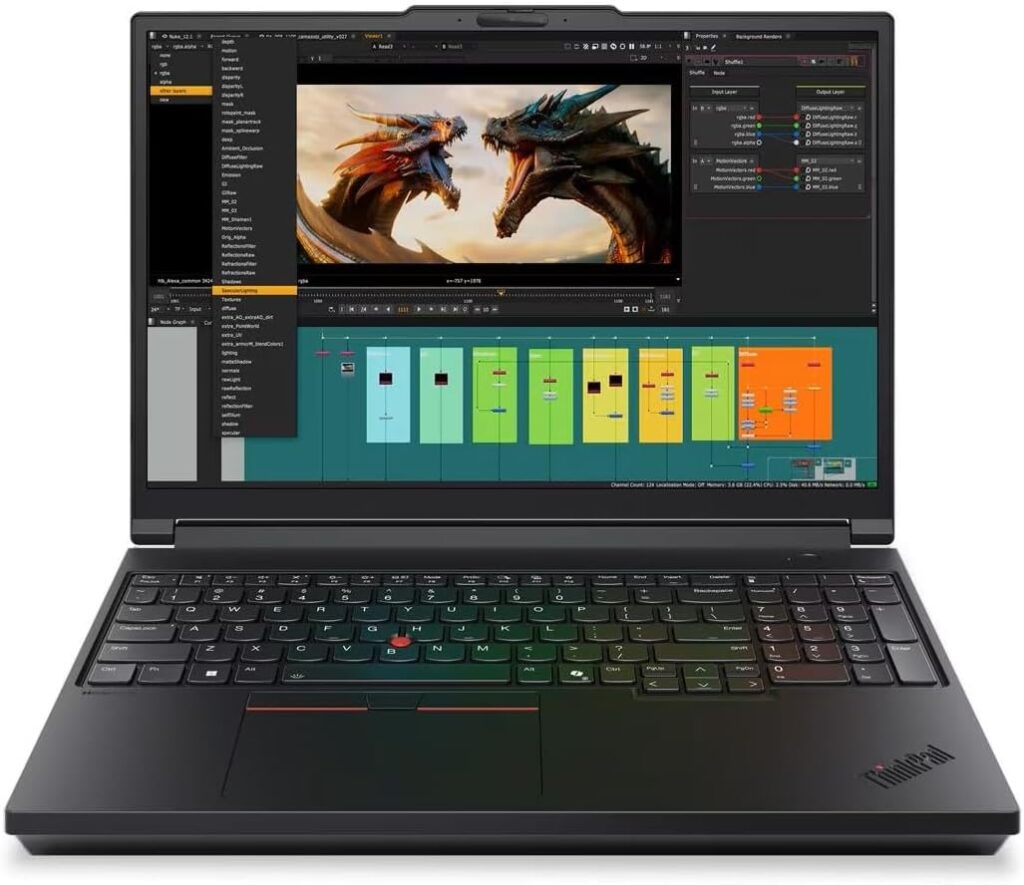
I’ve been hard on this machine’s power limits, so let me explain why it’s still here. For a lot of practices it’s the right answer — just not for the reason Lenovo’s marketing suggests.
What’s inside
- CPU: Intel Core Ultra 9 275HX, 24 cores (8 P to 5.4 GHz, 16 E to 4.6 GHz), 36 MB L3, 13 TOPS NPU. A 285HX option also exists
- GPU: Nvidia RTX Pro 5000 Blackwell, 24 GB GDDR7, 896 GB/s bandwidth, 10,496 shading units, 82 RT cores, 36.53 TFLOPS FP32 — capped by Lenovo at 105 W. Lower tiers run down to RTX Pro 1000
- RAM: 32 GB DDR5-5600 as standard, expandable to 192 GB across four SO-DIMM slots
- Storage: 1× PCIe 5.0 x4 M.2 occupied, plus 2× PCIe 4.0 x4 M.2 free
- Display: 16-inch 3200 × 2000 tandem OLED touch, 600 nits, 100% DCI-P3, DisplayHDR 600, 120 Hz VRR, anti-glare
- Ports: 2× Thunderbolt 5 (80 Gb/s), 1× Thunderbolt 4, 2× USB-A, HDMI 2.1, 2.5 GbE Ethernet, SD Express 8.0
- Battery: 99.9 Wh, 180 W USB-C charger
- Weight: 2.5 kg (5.6 lb)
- Certifications: ENERGY STAR 9.0, EPEAT Gold, TCO Certified Gen 10
- Price: From $3,527. XDA’s fully loaded review unit — 128 GB RAM, 4 TB SSD, RTX Pro 5000, 3.2K tandem OLED — came to $9,129
The performance reality. StorageReview’s enscape-01 score of 68.15 is the lowest of the four RTX Pro 5000 machines they’ve tested, and it’s entirely down to that 105 W cap. Notebookcheck was blunter, calling the new chassis an overcorrection: more mobile than the P16 Gen 2, but sacrificing the performance the P series exists to deliver. The 180 W USB-C charger is the giveaway — there simply isn’t enough power budget for the GPU to stretch.
What it wins instead. StorageReview measured 7 hours in the PCMark 10 Modern Office battery test. In the same test, the Dell Pro Max 18 Plus managed 3 hours 39 minutes and the HP ZBook Fury G1i 4 hours 48 minutes. The thing that costs it Enscape frames is the same thing that keeps it alive through a working day.
It also posted the highest Geekbench 6 single-core score of the three workstations StorageReview compared, at 3,024, ahead of both 285HX machines, and the highest PCMark 10 overall score at 10,618 against 8,581 and 8,667. Multi-core came in at 17,860, and GPU OpenCL at 220,751. ServeTheHome independently found the Dell Pro Max 16 Plus landing 3.1% behind the Lenovo in single-threaded performance despite a nominally faster chip, which they put down to Dell tuning more conservatively. For day-to-day Revit responsiveness, which is single-thread sensitive, that’s not nothing.
Storage. The Gen5 drive hit 7,926.1 MB/s read and 5,932.1 MB/s write in Blackmagic’s Disk Speed Test — the fastest read result of the three systems StorageReview compared.
Other measured results. V-Ray GPU 7,182. Blender GPU Classroom 1,694.35 samples per minute. 7-Zip total rating 127.8 GIPS. LuxMark Hallbench 25,640 and Food 10,754. Blackmagic RAW 8K playback at 104 fps on CPU and 143 fps via OpenCL. And notably, it took the top blender-01 score in SPECviewperf 15 at 95.53, beating both higher-powered machines — so the picture isn’t uniformly behind.
On battery. Notebookcheck measured its Cinebench R23 multi-core result dropping 26% to 27,728 points unplugged, and its 3DMark 11 GPU result falling 23% to 37,978. Plan around that.
Pros
- Up to 192 GB of user-replaceable RAM across four SO-DIMM slots — nothing else here comes close, and federated models eat RAM
- 7 hours of measured battery, roughly double its direct workstation rivals
- 24 GB VRAM on certified professional drivers
- Three M.2 slots with two free, and full ThinkPad serviceability
- Built-in 2.5 GbE, SD Express 8.0, dual Thunderbolt 5 at 80 Gb/s
- Fastest SSD read result of the workstations tested, at 7,926 MB/s
- Best Geekbench 6 single-core and PCMark 10 scores in its comparison group
- Excellent 600-nit tandem OLED with full DCI-P3 and anti-glare finish
- ENERGY STAR 9.0, EPEAT Gold and TCO Gen 10, which matters if your practice reports on procurement
Cons
- The 105 W GPU cap costs about 21% of Enscape performance versus the same GPU at 175 W
- The 180 W USB-C charger is the root cause, and there’s no way around it
- A further 23% GPU drop and 26% CPU drop when running on battery
- 2.5 kg, and it’s a full-size 16-inch workstation in every sense
- Top configurations get eye-watering in a hurry — up to $9,129 as XDA reviewed it
Who it’s for. Practices buying a fleet, and anyone whose bottleneck is model size rather than frame rate. If your Revit central file is enormous and Enscape is a review tool rather than your main output, the 192 GB ceiling matters far more in year three than twenty frames per second does in year one.
Head to head
| Dell Pro Max 16 Plus | MSI Raider 16 Max HX | Razer Blade 16 (2026) | ASUS ProArt P16 | ThinkPad P16 Gen 3 | |
|---|---|---|---|---|---|
| GPU | RTX Pro 5000 Blackwell | GeForce RTX 5090 | GeForce RTX 5090 | GeForce RTX 5090 | RTX Pro 5000 Blackwell |
| VRAM | 24 GB GDDR7 | 24 GB GDDR7 | 24 GB GDDR7 | 24 GB GDDR7 | 24 GB GDDR7 |
| GPU power ceiling | 175 W | 175 W | 175 W | 120 W | 105 W |
| CPU | Core Ultra 9 285HX | Core Ultra 9 290HX Plus | Core Ultra 9 386H | Ryzen AI 9 HX 370 | Core Ultra 9 275HX |
| Geekbench 6 single | 3,032 (StorageReview) | 3,231 (Tom’s Hardware) | 2,895 (Tom’s Hardware) | 2,919 (Notebookcheck) | 3,024 (StorageReview) |
| Geekbench 6 multi | 20,978 (StorageReview) | 20,656 (Tom’s Hardware) | 16,971 (Tom’s Hardware) | 15,567 (Notebookcheck) | 17,860 (StorageReview) |
| Max RAM | 128 GB CAMM2, replaceable | 32 GB as tested, SO-DIMM slots accessible | 32 GB soldered | 64 GB soldered | 192 GB, 4× SO-DIMM |
| Display | 4K 120 Hz OLED touch, 500 nits, 100% DCI-P3 | QHD+ 240 Hz OLED, 487.2 nits measured, ΔE 0.62 | 1600p 240 Hz OLED, 408.2 nits measured, 90% DCI-P3 | 4K 120 Hz tandem OLED touch, 666 nits measured, ΔE 0.5 | 3.2K 120 Hz tandem OLED touch, 600 nits, 100% DCI-P3 |
| Storage read (Blackmagic) | 7,755.6 MB/s | 4,790 MB/s | 2 TB PCIe 4.0; 1,735.09 MB/s in Tom’s 25 GB transfer | 2× 2 TB PCIe 4.0, second slot x2 | 7,926.1 MB/s |
| Battery (lab measured) | 6 h 21 m (StorageReview) / 2 h 37 m (TrustedReviews) | 8 h 34 m (Tom’s Hardware) | 12 h 46 m (Tom’s Hardware) | 7–9 h (Ultrabookreview) | 7 h 00 m (StorageReview) |
| Load thermals (measured) | Fans ~43 dB at 0.5 m (IT Pro); CPU mid-to-high 90s °C (91mobiles) | CPU 75 °C / GPU 72 °C (Tom’s Hardware) | CPU 75.3 °C / GPU 87 °C (Tom’s Hardware) | CPU 80–85 °C / GPU 80–82 °C flat on desk, 48 dB(A) (Ultrabookreview) | −26% CPU and −23% GPU on battery (Notebookcheck) |
| Weight | 2.55–2.85 kg | 2.6 kg | 2.14 kg | 1.95 kg | 2.5 kg |
| Ethernet | Yes, 2.5 GbE | Yes, 2.5 GbE | No | No | Yes, 2.5 GbE |
| ISV certified | Yes, 100+ | No | No | No | Yes |
| Price | From $2,779 | From $2,999 | $3,499–$4,899 | $3,999 MSRP | From $3,527 |
How much VRAM do you actually need?
Chaos’s official line is 8 GB minimum for professional work and 12 GB for VR, with a standing instruction to buy as much as you can. Here’s how I’d translate that into a purchase decision.
| Your typical project | Absolute minimum | What I’d actually buy |
|---|---|---|
| Single-family residential, small interiors | 8 GB | 12 GB, so you’re not resizing textures in two years |
| Mid-rise, small commercial, restaurant fit-outs | 12 GB | 16 GB |
| Large commercial, schools, hospitals, hotels | 16 GB | 24 GB |
| Federated models, linked consultants, masterplans | 24 GB | 24 GB, and stop worrying |
| Anything in VR | 12 GB per Chaos | 24 GB — headset resolutions are brutal |
The reason I push people towards 24 GB isn’t performance today. It’s that VRAM is the one component you can never upgrade later, on any laptop, ever. RAM you can sometimes add. Storage you can nearly always add. The GPU’s memory is soldered to the board for the life of the machine.
Getting the most out of Enscape once the laptop arrives
Some of these have saved people from buying a new machine they didn’t need.
Check the discrete GPU is actually being used. Optimus and similar switching systems occasionally hand Enscape to the integrated graphics, which Chaos explicitly says isn’t supported for full functionality. If Enscape feels inexplicably slow, check this first in the Nvidia app. Some of these machines offer a MUX switch or Advanced Optimus — the ProArt notably does not, it’s plain hybrid Optimus only.
Plug in for anything that matters. Notebookcheck measured a 23% GPU drop and a 26% CPU drop on battery on the ThinkPad. That’s not a Lenovo quirk, it’s the whole category. Find a socket before the client sits down.
Know what your power profile costs you before you need it. The ProArt’s Whisper mode costs about 39% of graphics performance versus Performance mode in Notebookcheck’s testing. That can be a fine trade for silence in a meeting — but decide it deliberately, not by accident.
Raise the laptop off the desk. Ultrabookreview measured the ProArt’s CPU dropping from 80–85 °C flat on a desk to 75–78 °C on a stand, with the GPU following. A twenty-pound laptop riser is the cheapest performance upgrade you’ll ever buy.
Turn DLSS on. Enscape’s DLSS 4 Super Resolution support with optimised presets exists precisely for this situation: a high-resolution laptop panel and a power-constrained GPU. It’s free performance in a walkthrough.
Use a cable for the asset library. Chaos recommends a wired connection over Wi-Fi because Cosmos asset loading suffers otherwise. This is why I keep flagging which machines have Ethernet.
Run one screen when you’re presenting, not three. Every extra pixel is GPU work that could have been frames.
What I’d avoid buying in 2026
Anything with 8 GB of VRAM. It sits below Chaos’s own professional recommendation and it will age badly.
A slim laptop where the manufacturer won’t publish the TGP. If they’re hiding it, it’s low. The enscape-01 table above shows exactly what that costs you.
An AMD GPU, for Enscape specifically. Ray Traced Artificial Lights is disabled on AMD in Enscape’s own release notes, and DLSS is Nvidia-only. In plenty of other software AMD is competitive. Here it isn’t.
An Arm-based Windows laptop, for now. That includes the very tempting RTX Spark ProArt P16 (H7607) arriving later this year. Chaos’s documentation says Windows 11 ARM is untested and unsupported. Wait for that sentence to change.
A MacBook, if you use Revit. Enscape for Mac is Apple Silicon only, and Revit doesn’t run on macOS at all.
Should you wait?
Two things worth weighing.
The memory market is ugly. PC Gamer attributed the Blade 16’s $400 year-over-year price rise largely to the ongoing memory crisis, and it’s showing up right across the industry. If you can wait six months, prices may soften. If you need the machine now, buy the machine now — a stuttering walkthrough in front of a client costs more than a few hundred dollars.
RTX Spark is coming, and it isn’t for you yet. ASUS’s ProArt P16 (H7607) and P14 (H7407) land in the second half of 2026 with 128 GB of unified memory and around 1 petaflop of AI performance. Exciting for AI developers. Unsupported for Enscape users until Chaos says otherwise.
What I would not wait for is another GPU generation. The RTX 50 series with 24 GB of VRAM handles everything Enscape currently throws at it. The bottleneck in 2026 is power delivery and cooling, not silicon.
Frequently asked questions
Chaos specifies a dedicated GPU with at least 4 GB of VRAM and Vulkan 1.1 support, with GeForce GTX 900 series, Quadro M series or AMD Radeon RX 400 series as the floor. But their actual recommendation for professional work is 8 GB or more, and 12 GB if you’re using VR. Integrated Intel graphics with shared memory doesn’t meet the requirement for full functionality.
No, but the badge alone tells you very little. SPECviewperf 15’s enscape-01 results show a 27% performance spread across four machines running the identical RTX Pro 5000 GPU at 105 W, 150 W and 175 W. Find the TGP before you buy — it matters more than the model number.
Only if your organisation requires ISV-certified drivers, or if you spend most of your day in Revit’s own viewport rather than in Enscape. Enscape itself is a Vulkan real-time renderer and doesn’t depend on the certified OpenGL paths that make professional cards worth the premium in CAD software. A GeForce RTX 5090 at 175 W will give you more Enscape performance per pound than a professional card at 105 W.
The verdict
If I had to squeeze six thousand words into one line: buy VRAM you can’t upgrade, buy watts you can’t add later, and ignore the model name on the box.
For most architects reading this, the MSI Raider 16 Max HX is the right machine. Full 175 W RTX 5090, 24 GB of VRAM, the best measured thermals in this group at 75 °C CPU and 72 °C GPU under sustained load, 8 hours 34 minutes of battery, a panel that measures ΔE 0.62, and it costs meaningfully less than the certified workstations. Unless your IT department mandates ISV certification, this is where the money goes furthest.
If the firm is paying and the models are enormous, the Dell Pro Max 16 Plus posted the highest Enscape score of any 16-inch laptop I’ve found data for, at 84.84. Budget for the weight and treat the battery as a formality.
If you live out of a bag, the Razer Blade 16 (2026) is the only laptop here that’s properly portable while still feeding its GPU 175 W. Take the $3,999 RTX 5080 configuration and put the difference towards a good dock — and go in knowing that model loading will be slower than on the HX machines.
If your product is the image, the ProArt P16‘s ΔE 0.5 panel earns its keep every day, as long as you accept the 120 W GPU ceiling.
And if you’re buying for a studio, the ThinkPad P16 Gen 3‘s 192 GB memory ceiling and seven-hour battery will matter far more in year three than the frames it gives up in year one.
Whichever way you go, check the TGP. Please. It’s the number that decides how your walkthrough feels, and it’s the one nobody puts on the marketing page.
Every performance figure in this article was measured and published by a named independent laboratory, credited inline: StorageReview (SPECviewperf 15, Blackmagic Disk and RAW, Geekbench 6, PCMark 10, V-Ray, Blender, LuxMark, 7-Zip, battery), Notebookcheck (display metrology via X-Rite i1Pro 3, Cinebench, 3DMark, fan noise, power profiles, battery-mode derating), Tom’s Hardware (gaming, surface and component temperatures, battery, file transfer, display), Ultrabookreview (X-Rite i1 Display Pro screen measurements, sustained CPU and GPU temperatures, head-level noise, SPECviewperf 2020, Blender, battery), plus ServeTheHome, PCWorld, PC Gamer, TechRadar, TrustedReviews, IT Pro, 91mobiles, XDA and NoobFeed. Software behaviour is taken from Chaos’s official Enscape documentation and release notes. Prices reflect manufacturer and retailer listings at the time of writing and move constantly in the current memory market.

Hi, my name is Burak. I am a mechanical engineer. I have been writing laptop reviews for the Engineering Laptops website since 2020. Please feel free to contact me if you have any questions.





1 thought on “Best Laptop for Enscape (2026) — (Tested & Benchmarked)”