
Estimated reading time: 17 minutes
Key Takeaways
- The best laptop for Altium Designer in 2026 is the Lenovo Legion Pro 5i Gen 10, offering fast performance without breaking the bank.
- For professionals needing no compromises, consider the Lenovo ThinkPad P1 Gen 8. Meanwhile, the Acer Nitro V 16 AI is ideal for budget-conscious users.
- Key specifications for Altium include at least 32 GB of RAM, a fast single-core CPU, and a minimum 1 TB NVMe SSD for optimal performance.
- Graphics performance matters — avoid expensive workstation GPUs and opt for modern gaming cards instead, as they perform equally well for Altium.
- The best laptops for Altium Designer come down to your needs: portability, budget, and whether you multitask with MCAD tools.
Table of contents
Let me save you some time right up front. If you want the best all-around laptop for Altium Designer in 2026, get the Lenovo Legion Pro 5i Gen 10. It’s the one I recommend to most working engineers because it nails every single thing Altium actually uses — fast single-core speed, 32 GB of RAM, a quick NVMe drive, and a solid graphics card — without making you spend workstation money. If Altium pays your bills and you want a no-compromise machine, step up to the Lenovo ThinkPad P1 Gen 8. And if you’re broke or just starting out, the Acer Nitro V 16 AI will get the job done.
That’s the cheat sheet. But there’s a lot of bad advice floating around about what Altium “needs,” so stick with me. I’ve been routing boards in this software for years, and the two questions I hear constantly are “do I need a Quadro?” and “is 16 GB enough?” The short answers are no and not really — and once you understand why, picking the right laptop gets a whole lot easier.
Below you’ll find five real machines, spread across every budget from about $700 to well past $3,500, plus a plain-English breakdown of what to look for and a few tables to help you compare at a glance.
What Altium Designer Actually Wants From a Laptop
Before we talk specific machines, let’s clear up what the software genuinely cares about. Here’s what Altium officially lists, side by side, so you can see the gap between “it’ll technically run” and “it’ll run well“:
| Component | Bare Minimum | What You Actually Want |
|---|---|---|
| Operating System | Windows 10 64-bit | Windows 11 64-bit |
| Processor | Intel Core i5 or equivalent | Core i7 (12th Gen) or newer, high clock speed |
| Memory (RAM) | 4 GB | 32 GB |
| Storage | 10 GB free | 1 TB+ NVMe SSD |
| Graphics | Any DirectX 11 card | GeForce GTX 1060 / RX 470 class or better |
| Display | 1680×1050 | Dual monitors at 2560×1440 or higher |
Now, ignore that “minimum” column the moment you’ve read it. Four gigs of RAM is a joke for anything real. Here’s what genuinely moves the needle.
Processor: Single-Core Speed Wins the Day
This is the big one, and it’s where most people overthink things. Altium leans hard on single-threaded performance. The stuff you do all day long — dragging traces, push-and-shove routing, opening schematics, running design rule checks, and especially re-pouring those big copper polygons — mostly hammers one or two cores, not all of them at once.
What that means in practice: a chip that boosts to 5.2 GHz on one core will feel faster in everyday editing than a chip with twice the cores but lower clocks. So when you’re shopping, look at the boost clock first. A current Intel Core Ultra 7/9 or AMD Ryzen AI 9 with a boost around 5.0–5.5 GHz is exactly the sweet spot. More cores still help when you’re compiling, rebuilding the 3D view, or running Altium next to a mechanical CAD tool and forty browser tabs of datasheets — but raw clock speed is what makes the day-to-day feel snappy.
Memory: 32 GB Is the Real Floor
Altium recommends 32 GB, and honestly, that’s the number I’d treat as your actual minimum for any new laptop in 2026. It’s normal to see Altium, a browser, and an MCAD package together chewing through 20–25 GB. Sixteen gigs works for small boards, but you’ll feel it the moment your design gets complex or you start multitasking.
One thing to know going in: RAM prices shot up hard in 2026 thanks to a global memory shortage, so the jump from 16 GB to 32 GB costs more than it used to. It’s still worth it — but it makes one feature really valuable: upgradeable RAM. If a laptop uses removable SO-DIMM sticks (like the Legion and the Nitro V below), you can start at 16 GB and add more later. If the RAM is soldered to the board, you have to buy the 32 GB version up front, because you’ll never be able to add to it.
Graphics: Skip the Expensive “Pro” Card
Here’s the myth I most want to kill. You do not need a workstation GPU — no Quadro, no RTX Pro, no Radeon Pro — for Altium.
Why? Because Altium’s graphics engine is built on DirectX 11, not OpenGL. And the company itself says, in plain terms, that ordinary gaming-class GeForce and Radeon cards perform just as well or better than workstation cards that cost twice as much. They literally recommend buying a gaming card instead.
The only real rule is a performance floor: Altium says don’t go below about 700 GFLOPS of GPU horsepower. To put that in perspective, a budget Radeon RX 470 from years ago already hit nearly 3,800 GFLOPS. Any modern laptop graphics chip — even an entry-level RTX 5050 — sails miles past that line. Heck, if you only dip into the 3D view occasionally, even good integrated graphics (Intel Arc, Radeon 890M) will do fine. A real discrete GPU only becomes important if you do heavy 3D PCB visualization or run a mechanical CAD tool like SolidWorks alongside Altium.
So please, don’t let a salesperson talk you into a $6,000 “certified workstation GPU” for a job a $1,500 gaming laptop does just as well.
Storage: Fast, and at Least 1 TB
The install itself is tiny — about 10 GB. But a fast PCIe NVMe SSD makes project loading, library access, and compiles noticeably quicker than an old SATA drive. Get at least 1 TB. Between your libraries, Altium 365 caches, MCAD models, and Windows itself, space disappears faster than you’d think.
Display: Sharpness Over Color Accuracy
Altium is a precision drafting tool, not a photo-editing app. That means screen resolution and physical size matter way more than how punchy the colors are. The comfortable sweet spot is a 16-inch panel at 2.5K (2560×1600) or higher. Altium actually recommends two monitors at 2560×1440 or better, so plan to dock to an external display at your desk.
One quirk worth knowing: Altium doesn’t handle different scaling settings across two monitors well — it applies your main screen’s scaling to both — so matched external displays make for the smoothest dual-screen life.
Cooling: Can It Hold Its Speed?
Since Altium loves clock speed, you want a laptop that can actually sustain those high clocks instead of throttling down after 30 seconds. Thin-and-light laptops look gorgeous but tend to throttle sooner. Thicker performance laptops and workstations keep their clocks up longer under load. Keep that trade-off in mind as you read the picks below.
Quick Picks at a Glance
| If this is you… | Get this | Ballpark price |
|---|---|---|
| Pro who wants the best portable workstation, built to last | Lenovo ThinkPad P1 Gen 8 | $3,500+ |
| Heavy ECAD + MCAD user who wants a gorgeous screen | ASUS ProArt P16 | ~$2,400 |
| Working engineer who wants the most performance per dollar | Lenovo Legion Pro 5i Gen 10 | ~$1,800–2,100 |
| Tight budget, small-to-medium boards | Acer Nitro V 16 AI | ~$700–1,000 |
| Always on the move, mostly schematic + 2D layout | ASUS Zenbook 14 OLED | ~$1,000–1,300 |
The 5 Best Laptops for Altium Designer in 2026
1. Lenovo ThinkPad P1 Gen 8 — Best Premium Workstation
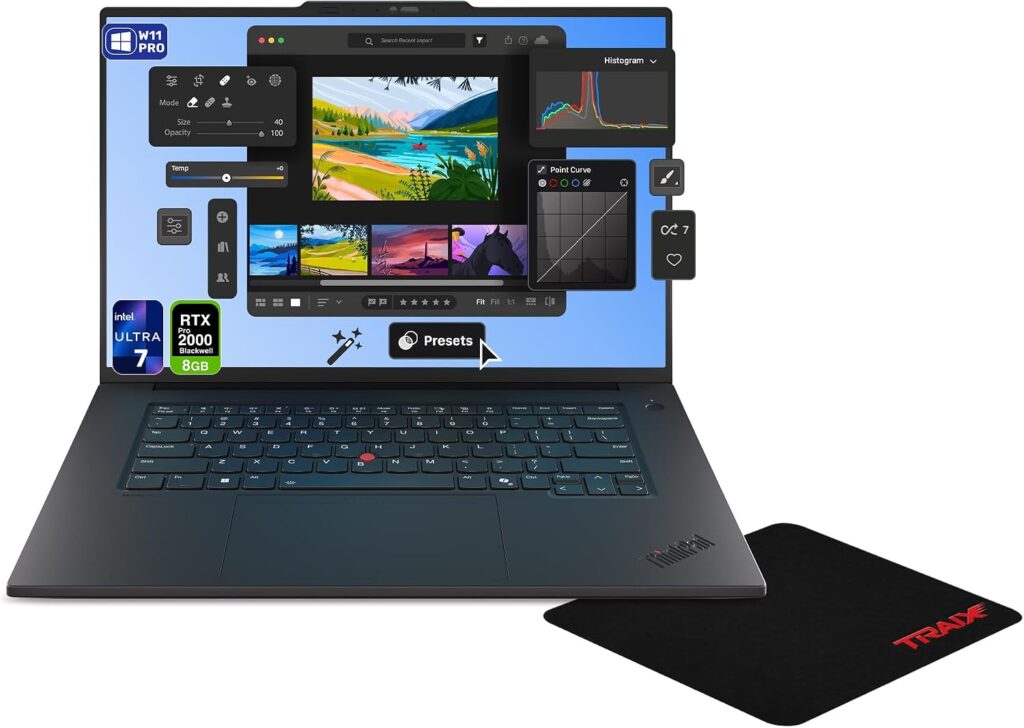
This is the one you buy when Altium is your livelihood and you want zero excuses. The Gen 8 moved to Intel’s Arrow Lake-H chips and NVIDIA’s newest Blackwell-generation RTX Pro graphics, added Thunderbolt 5, and offers a stunning tandem-OLED display — all wrapped in a 4-pound carbon-fiber-and-magnesium body that’s built like a vault.
Key specs:
- CPU: Intel Core Ultra 7 255H (16 cores, up to 5.1 GHz), up to Core Ultra 9 285H (5.4 GHz)
- GPU: NVIDIA RTX Pro 2000 Blackwell, 8 GB GDDR7 (or RTX Pro 1000, or integrated Arc on base)
- RAM: 32 GB LPDDR5X, up to 64 GB via LPCAMM2 — and it’s user-upgradeable
- Storage: 1 TB PCIe Gen 5 SSD, expandable to 8 TB across two slots
- Display: 16″ 16:10, up to 3.2K tandem OLED touch, or 4K IPS
- Ports: 2× Thunderbolt 5, Thunderbolt 4, USB-A, HDMI 2.1, SD Express
- Build: MIL-STD-810H tested, ~4 lb, Wi-Fi 7, that legendary ThinkPad keyboard
What’s great:
- Excellent single- and multi-core speed, with cooling good enough to actually sustain it
- The RTX Pro 2000 is wild overkill for Altium — it will never, ever be your bottleneck
- Genuinely upgradeable memory and dual SSD slots, which is rare in a laptop this slim
- ISV-certified, MIL-spec tough, and a keyboard you’ll genuinely enjoy
- Holds its resale value better than almost anything else here
What’s not:
- It’s pricey — to get the discrete GPU you’re looking at $3,500+, and a maxed-out build blows past $6,700
- You’re paying a premium for a “Pro” GPU that Altium flat-out says you don’t need
- Battery drains quickly and it warms up under sustained heavy load
Bottom line: Perfect for professionals and teams who need rock-solid reliability, easy servicing, and serious MCAD muscle on top of Altium. If your work is purely Altium, though, you’re overpaying — read on.
2. ASUS ProArt P16 — Best for ECAD + MCAD

This is the machine I point people toward when they live in both worlds — electrical and mechanical CAD. The ProArt P16 pairs a quick AMD Ryzen AI 9 chip with a real GeForce RTX 50-series GPU and a knockout OLED screen, all in a slim 4-pound body that doesn’t scream “gaming rig.”
Key specs:
- CPU: AMD Ryzen AI 9 HX 370 (12 cores / 24 threads, up to 5.1 GHz)
- GPU: NVIDIA GeForce RTX 5070 Laptop, 8 GB GDDR7 (configs go up to RTX 5090)
- RAM: 32 GB LPDDR5X (soldered; 64 GB option)
- Storage: 2 TB PCIe 4.0 SSD
- Display: 16″ 3K (2880×1800) OLED, 120Hz touch, Pantone-validated, Delta E < 1
- Ports: USB4, USB-C, 2× USB-A, HDMI 2.1, SD Express; Wi-Fi 7
- Build: ~0.59″ thin, ~4.08 lb, MIL-grade, with the handy ASUS DialPad
What’s great:
- Strong single-core for Altium’s interactive editing, plus 12 cores for everything else
- The RTX 5070 is far more than Altium needs and superb for SolidWorks and 3D rendering
- That 3K 120Hz OLED is a gorgeous, roomy canvas for schematics and layout
- Slim, light, classy — with great speakers, keyboard, and touchpad
- 2 TB of storage standard means no day-one shuffling
What’s not:
- RAM is soldered, so choose 32 GB or 64 GB at checkout — no upgrades later
- Being thin, it throttles a touch versus thicker machines, and the fans get audible under load
- No fingerprint reader and a weak webcam for a “pro” machine
Pricing: The RTX 5070 / 32 GB / 2 TB build runs around $2,399; the line starts near $2,199 and a maxed RTX 5090 config climbs toward $2,899–$3,999.
Bottom line: Ideal for engineers who bounce between ECAD and MCAD, want a top-tier display, and would love one beautiful machine for design and content work.
3. Lenovo Legion Pro 5i Gen 10 — Best Value Overall
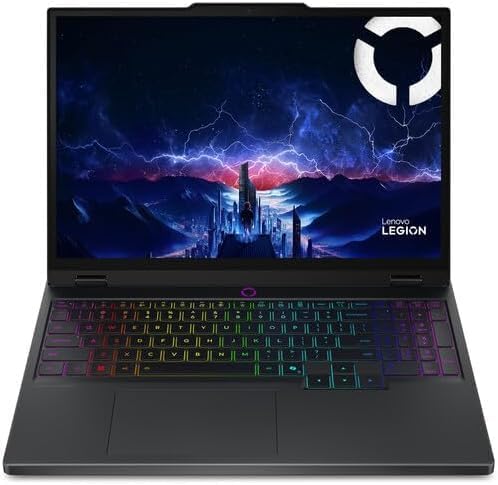
This is my smart-money pick and the first laptop most working engineers should look at. It hands you a top-tier HX-class CPU, a current RTX 50-series GPU, 32 GB of RAM, and a lovely high-refresh screen — for far less than any workstation. Crucially, it checks every box Altium genuinely cares about and then some.
Key specs:
- CPU: Intel Core Ultra 7 255HX (20 cores) or Core Ultra 9 275HX (24 cores, 5.2+ GHz)
- GPU: NVIDIA GeForce RTX 5070 8 GB GDDR7 (or RTX 5070 Ti 12 GB)
- RAM: 32 GB DDR5 — removable SO-DIMM, so you can upgrade it yourself
- Storage: 1 TB (some configs 2 TB) PCIe SSD
- Display: 16″ 2.5K (2560×1600), 165Hz+, 500 nits (OLED on some versions)
- Ports: Thunderbolt 4 / USB4, USB-C, multiple USB-A, HDMI 2.1, real RJ-45 Ethernet; Wi-Fi 7
- Build: ~5.4 lb, strong dual-fan cooling
What’s great:
- HX-class CPU with excellent single-core and class-leading multi-core — ideal for Altium plus compiling and heavy multitasking
- Upgradeable RAM and standard M.2 slots — a huge plus during the 2026 memory crunch
- Genuinely strong cooling that sustains high clocks better than thin laptops
- The RTX 5070 blows past Altium’s GPU needs and is a great all-rounder
- A real Ethernet port, which is handy on the lab bench or shop floor
What’s not:
- It’s a gaming laptop — heavier, with RGB lighting, and not exactly “boardroom” looking
- Battery life and portability lag the thin-and-lights
- 2026 component pricing has nudged street prices up a bit
- 8 GB of VRAM is plenty for Altium but modest for heavy GPU rendering
Bottom line: The pragmatic choice for the engineer who wants the most Altium performance per dollar and doesn’t care that it’s technically a gaming machine. This is the value champ — full stop.
4. Acer Nitro V 16 AI — Best Budget Pick

Money tight? The Nitro V 16 AI gets you into a real, discrete-GPU Altium machine for entry-level cash. It puts most of its budget into the graphics card and pairs it with a basic CPU — and for small to medium boards, that’s a perfectly sensible trade.
Key specs:
- CPU: AMD Ryzen 5 240 (6 cores / 12 threads, up to 5.0 GHz) — entry-level
- GPU: NVIDIA GeForce RTX 5050 8 GB GDDR7 (up to 95W)
- RAM: 16 GB DDR5 — upgradeable, with a free second slot
- Storage: 512 GB PCIe Gen 4 SSD (1 TB configs exist)
- Display: 16″ WUXGA (1920×1200) IPS, 180Hz, 100% sRGB
- Ports: USB4, USB-A, HDMI 2.1, microSD, Gigabit Ethernet; Wi-Fi 6E
- Build: Dual-fan cooling, surprisingly good battery life for the class
What’s great:
- The cheapest credible way into a discrete-GPU Altium laptop — often $700–1,000
- That RTX 5050 still crushes Altium’s GPU requirement, so graphics won’t hold you back
- DDR5 RAM is upgradeable, so you can (and should) take it to 32 GB
- A 16″ 1920×1200 screen gives more vertical room than old 15.6″ 1080p panels
- Looks understated and lasts decently on battery
What’s not:
- The Ryzen 5 240 is the weakest CPU here — big-board routing and DRC will feel slower
- Ships with 16 GB and a 512 GB SSD, so budget upgrades in from day one
- Lowest screen resolution of the bunch (still fine, just not luxurious)
- Build quality is, unsurprisingly, budget-grade
Bottom line: Great for students, hobbyists, and anyone working on small-to-medium boards who needs to spend as little as possible. Just plan on that RAM upgrade right away.
5. ASUS Zenbook 14 OLED — Best Lightweight & Portable

Sometimes you just need something light you can toss in a bag, run schematics on at a client’s office, and do comfortable 2D layout work. The Zenbook 14 OLED is that machine: a fast modern CPU with strong single-core speed, a beautiful OLED, all-day battery, and a weight under three pounds.
Key specs:
- CPU: Intel Core Ultra 7 255H (16 cores, up to 5.1 GHz), Core Ultra 9 285H option
- GPU: Intel Arc 140T integrated (no discrete option)
- RAM: 16 GB LPDDR5X (32 GB on higher configs; soldered)
- Storage: 512 GB–1 TB PCIe 4.0 SSD
- Display: 14″ OLED, up to 3K (2880×1800), 120Hz, 100% DCI-P3
- Ports: 2× Thunderbolt 4, USB-A, HDMI 2.1; Wi-Fi 7
- Build: ~2.7 lb, all-metal, ~75 Wh battery
What’s great:
- Excellent single-core speed, so Altium’s interactive editing feels snappy
- One of the most portable machines that can still run Altium properly; superb battery life
- Gorgeous high-res OLED in a 14″ frame, with a great keyboard for something this thin
- Two Thunderbolt 4 ports let you drive external monitors for a real desk setup
What’s not:
- Integrated graphics only — fine for 2D and light 3D, but not for heavy 3D PCB or MCAD
- Soldered RAM, and many configs ship with just 16 GB, so pick the 32 GB version
- The thin chassis throttles under long, heavy compute
- A 14″ screen is tight for complex layouts unless you dock to a monitor
Pricing: Core Ultra 7 / 16 GB / 2K OLED configs start around $999 (and have dipped near $700 on sale); the Core Ultra 9 / 32 GB / 2.8K OLED build lands around $1,299.
Bottom line: The pick for mobile-first engineers and consultants who mostly do schematic capture and 2D layout, then dock to a monitor at the desk. Get the 32 GB version and you’ll be happy.
Side-by-Side Comparison
| ThinkPad P1 Gen 8 | ProArt P16 | Legion Pro 5i Gen 10 | Acer Nitro V 16 AI | Zenbook 14 OLED | |
|---|---|---|---|---|---|
| Best for | Premium workstation | ECAD + MCAD | Best value | Budget | Portability |
| CPU | Core Ultra 7/9 H | Ryzen AI 9 HX 370 | Core Ultra 7/9 HX | Ryzen 5 240 | Core Ultra 7/9 H |
| Single-core | Excellent | Excellent | Excellent | Fair | Excellent |
| Multi-core | Very good | Very good | Class-leading | Modest | Good |
| GPU | RTX Pro 2000 | RTX 5070 | RTX 5070 | RTX 5050 | Arc 140T (integrated) |
| RAM | 32–64 GB (upgrade) | 32–64 GB (soldered) | 32 GB+ (upgrade) | 16 GB (upgrade) | 16–32 GB (soldered) |
| Storage | 1–8 TB | 2 TB | 1–2 TB | 512 GB–1 TB | 512 GB–1 TB |
| Display | 16″ 3.2K OLED | 16″ 3K OLED | 16″ 2.5K 165Hz | 16″ 1200p 180Hz | 14″ 3K OLED |
| Weight | ~4 lb | ~4.08 lb | ~5.4 lb | ~5 lb | ~2.7 lb |
| Approx. price | $3,500+ | ~$2,400 | ~$1,800–2,100 | ~$700–1,000 | ~$1,000–1,300 |
Which One Should You Buy?
No fluff — here’s how I’d decide:
- Budget under ~$1,100? → Acer Nitro V 16 AI, and add a second RAM stick to hit 32 GB.
- Need maximum portability, mostly schematic + 2D work? → ASUS Zenbook 14 OLED (32 GB version), docked to a monitor at your desk.
- Want the most Altium performance per dollar and don’t mind a gaming look? → Lenovo Legion Pro 5i Gen 10. This is the right answer for most engineers.
- Do heavy MCAD/3D alongside Altium and want a premium OLED in a slim body? → ASUS ProArt P16.
- Need ISV certification, MIL-spec durability, and upgradeable memory — and price isn’t the issue? → Lenovo ThinkPad P1 Gen 8.
The simplest rule of all: if your work is purely Altium, the Legion Pro 5i is all the laptop you need. Only move up to the ProArt or ThinkPad if mechanical CAD, rendering, durability, or company IT policy push you there.
Before You Buy: A Quick Checklist
Run through this before you click the order button:
- 32 GB of RAM — and if it’s soldered, make sure you selected it in the configurator
- A fast NVMe SSD, 1 TB or more (not an old SATA drive)
- A CPU that boosts around 5.0 GHz or higher for Altium’s single-thread-heavy work
- A DirectX 11 graphics card — any modern RTX or recent integrated GPU clears the bar easily
- A 2.5K or higher display, ideally 16″, and plan for at least one external monitor
- Windows 11 64-bit
- Good sustained cooling if you work on large boards for hours at a stretch
- Enough Thunderbolt/USB-C ports to drive your external displays
- Grab fresh graphics drivers straight from NVIDIA or AMD once the laptop arrives
Frequently Asked Questions
No. Altium’s graphics engine runs on DirectX 11, and Altium itself recommends ordinary gaming cards over workstation cards because they perform as well or better for a lot less money. Any modern GeForce RTX or Radeon GPU is great — and even strong integrated graphics handle occasional 3D work just fine.
For small boards and light multitasking, it works. But Altium recommends 32 GB, and that’s what I’d call the real minimum for a new machine in 2026, especially if you keep a browser and a mechanical CAD tool open alongside it.
Mostly one or two cores for the interactive editing you do all day — routing, dragging, re-pouring polygons, running DRC. Extra cores help with compiling, rebuilding the 3D view, and multitasking. So chase high clock speed first, then core count.
Not natively — Altium is Windows-only, with no Mac version. You can run it through Parallels Desktop on Apple Silicon, and people report it’s usable for schematic and layout work, though 3D and large boards get sluggish. Heads up: Altium officially does not support running the software in virtual machines or emulators, so for serious work a native Windows laptop is the safer bet. And Boot Camp isn’t an option on Apple Silicon Macs.

Hi, my name is Burak. I am a mechanical engineer. I have been writing laptop reviews for the Engineering Laptops website since 2020. Please feel free to contact me if you have any questions.