Estimated reading time: 22 minutes
Key Takeaways
- In 2026, laptops can effectively run 3ds Max, but many don’t meet essential performance needs.
- The ASUS ProArt P16 is the best overall choice, while the Lenovo Legion Pro 7i Gen 10 offers unbeatable value.
- For heavy rendering, the MSI Titan 18 HX AI excels, and the Lenovo ThinkPad P1 Gen 8 is best for certified workstations.
- The Lenovo Legion 5 presents a great budget option for beginners, handling 3ds Max well.
- Focus on real-world performance aspects like RAM, GPU capabilities, and cooling when selecting the best laptops for 3ds Max.
Table of contents
- Quick Picks: The Short Version
- What Actually Matters in a Laptop for 3ds Max
- The 5 Best Laptops for 3ds Max in 2026
- Full Comparison: All 5 Laptops Side by Side
- Which One Fits Your Workflow?
- Buying Tips Before You Click “Order”
- Frequently Asked Questions
- Is 32GB of RAM enough for 3ds Max?
- Do I need an NVIDIA RTX GPU for 3ds Max?
- Can gaming laptops run 3ds Max?
- What matters more for 3ds Max: CPU cores or clock speed?
- How much VRAM do I need for GPU rendering?
- Are workstation GPUs like the RTX PRO series worth it over GeForce?
- Should I buy a thin creator laptop or a thick desktop replacement?
- The Bottom Line
I still remember the first time I tried to run a full archviz scene on a laptop that “met the minimum requirements.” The viewport stuttered like a slideshow, the fans screamed, and somewhere around the two-hour mark of a render that should have taken twenty minutes, I gave up and drove back to the office. That was years ago, but the lesson stuck: 3ds Max doesn’t care what the spec sheet says. It cares about a handful of very specific things, and if your laptop gets those wrong, no amount of marketing gloss will save you.
The good news? In 2026, you can genuinely run serious 3ds Max work on a laptop — modeling, animation, even production rendering — without wanting to throw the thing out a window. The hardware finally caught up. The bad news is that laptop makers still sell plenty of machines that look great on paper and fall apart the moment you load a heavy scene.
So this guide is my attempt to save you from my old mistakes. Five laptops, each one picked for a real reason, with honest talk about where each falls short. No fluff, no “any RTX laptop will do.” Let’s get into it.
Quick Picks: The Short Version
In a hurry? Here’s where I’d point you:
- Best overall: ASUS ProArt P16 — the rare creator laptop that nails power, display, and portability all at once
- Best value: Lenovo Legion Pro 7i Gen 10 — near-workstation muscle at a price that makes the pro machines blush
- Best workstation-class: Lenovo ThinkPad P1 Gen 8 — certified drivers, bulletproof build, four pounds
- Best for heavy rendering: MSI Titan 18 HX AI — a desktop replacement that simply refuses to throttle
- Best budget option: Lenovo Legion 5 — proof you don’t need $4,000 to run Max properly
If you just want the one-sentence answer: most people should buy the ProArt P16 or the Legion Pro 7i. The other three exist for very specific, very legitimate reasons, and I’ll explain exactly who they’re for.
What Actually Matters in a Laptop for 3ds Max
Before we talk about specific machines, let me walk you through what 3ds Max actually does with your hardware — because it’s genuinely weird, and half the buying advice floating around online gets it backwards.
The viewport runs on one fast core, not twenty slow ones
Here’s the thing nobody tells beginners: the everyday feel of 3ds Max — orbiting the camera, pushing vertices around, stacking modifiers, scrubbing the timeline — is almost entirely a single-threaded job. One core does the heavy lifting while the rest of your fancy CPU sits there twiddling its thumbs.
That’s why a chip that boosts to 5.5 GHz feels dramatically snappier in the viewport than a chip with more cores but lower clocks. When you’re modeling, clock speed is king. Full stop.
Then you hit render, and everything flips. CPU render engines — Arnold (which ships with Max), V-Ray CPU, Corona — will happily devour every core and thread you can feed them, scaling almost linearly. Double the cores, nearly halve the render time. This is the eternal tension in every 3ds Max machine: you want blistering single-core speed for the hours you spend modeling, and a pile of cores for the hours you spend rendering. The best modern chips — Intel’s HX-class parts especially — pull off both by clocking a few cores sky-high when you’re working interactively and spreading the load wide when you hit render.
GPU and VRAM: it depends entirely on whether you GPU-render
Let me split this in two, because people conflate them constantly.
For the viewport alone, 3ds Max is surprisingly undemanding. The Nitrous viewport runs on DirectX, and any current GPU with 8GB of video memory will push millions of polygons around smoothly. If you never render on the GPU, you don’t need a monster graphics card. Honestly.
But the moment you touch GPU rendering, the graphics card becomes the whole conversation. V-Ray GPU and Arnold GPU both run on NVIDIA’s CUDA and OptiX technology — and Arnold GPU works only on NVIDIA cards, period. That single fact is why I steer every 3ds Max buyer toward NVIDIA RTX rather than AMD or Intel graphics. Maybe you don’t GPU-render today. But locking yourself out of that door to save a hundred bucks is a bad trade.
Two numbers matter for GPU rendering:
- CUDA core count — this is raw speed. Within a GPU generation, render performance scales almost directly with core count.
- VRAM — this is your ceiling. Your entire scene — geometry, textures, buffers, all of it — has to fit inside the GPU’s memory. Run out, and your render either crawls or crashes with an out-of-memory error. There’s no graceful fallback.
That second point is why the 24GB on the RTX 5090 Laptop GPU is such a big deal for rendering artists, and why an 8GB card — perfectly fine for viewport work — will start frustrating you the moment your scenes get heavy. My practical rule: 12GB is the working minimum for production GPU rendering, and 24GB is where you stop thinking about it.
RAM: 32GB is the floor, 64GB is where you relax
I’ll keep this simple. In 2026, 16GB is student territory. For professional work, 32GB is the absolute floor — Max itself rarely needs more than that for typical scenes. But if you do complex, high-resolution CPU rendering, or you run Max next to Photoshop, a browser stuffed with reference tabs, and Substance all at once (so, a normal Tuesday), 64GB is the amount that lets you stop thinking about memory entirely.
One extra rule if you GPU-render: your system RAM should be at least double your VRAM. A 24GB GPU wants 48GB+ of system memory behind it. Yet another reason 64GB is the sweet spot.
Storage: NVMe, and ideally two of them
Easiest section in this guide. Get an NVMe SSD — scene files, texture libraries, and autosaves live and die by drive speed. If the laptop has two M.2 slots, use them: OS and apps on one, active projects on the other. Storage is the cheapest performance upgrade you’ll ever buy.
The display matters more than you think
You’re going to stare at this screen for eight hours a day making color decisions that clients pay for. A panel covering 100% DCI-P3 or a properly calibrated 100% sRGB isn’t a luxury — it’s the difference between your render looking right on your screen and looking right on everyone else’s. The OLED and mini-LED panels showing up in 2026 laptops are genuinely spectacular. Just check for factory calibration and a documented gamut figure, not just “vivid colors” marketing.
A quick word on certified drivers
Autodesk officially certifies NVIDIA’s professional RTX PRO cards (the line formerly known as Quadro) for 3ds Max, while consumer GeForce cards get “tested” status instead. What does that mean in practice? Both work. GeForce on the Studio driver is rock solid for the overwhelming majority of artists, and it’s what I use for GPU rendering and game work. The pro cards earn their premium in two situations: your studio’s pipeline demands officially supported hardware, or you need workstation-only features like ECC memory. Everyone else can pocket the difference.
The 5 Best Laptops for 3ds Max in 2026
1. ASUS ProArt P16 — Best Overall
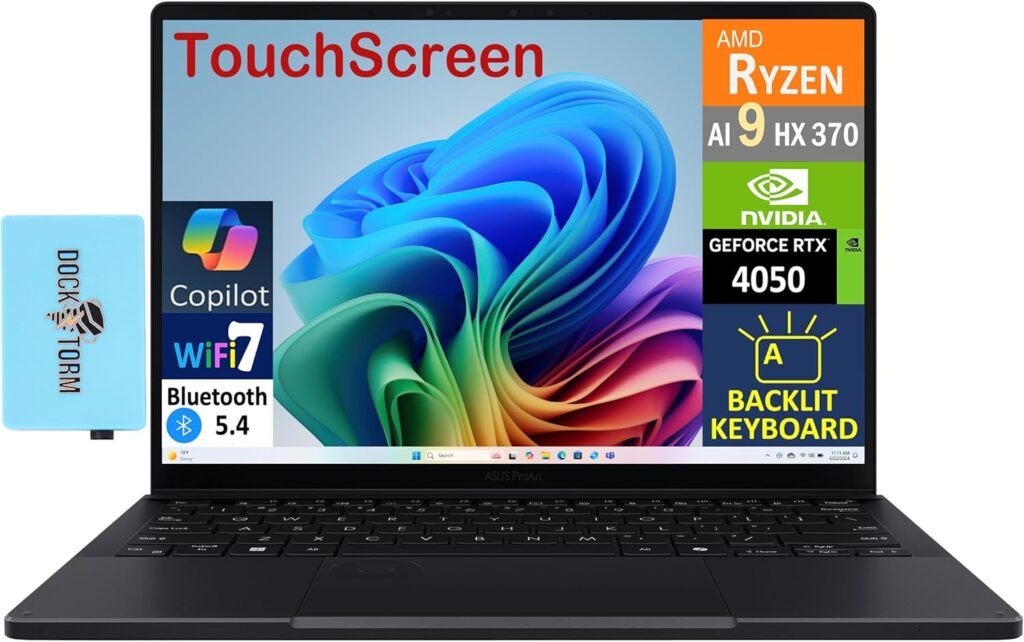
Key specs:
- CPU: AMD Ryzen AI 9 HX 370 (12 cores / 24 threads, up to 5.1 GHz)
- GPU: NVIDIA GeForce RTX 5090 Laptop, 24GB GDDR7 (up to 120W)
- RAM: 64GB LPDDR5X
- Storage: Up to 4TB across dual PCIe 4.0 NVMe slots
- Display: 16″ 4K (3840×2400) tandem OLED, 120Hz, 100% DCI-P3, PANTONE Validated, touch
- Weight: About 4.3 lbs
- Price: Around $3,999 with the RTX 5090; from ~$2,499 with lower GPU tiers
This is the laptop I recommend to most working artists, and the reason is simple: ASUS built it for people like us instead of dressing up a gaming machine and calling it a day.
Start with the screen, because it’s the best on this list. A 4K tandem OLED with full DCI-P3 coverage and factory Pantone validation means that when you’re doing lookdev at midnight, you can actually trust what you’re seeing. After years of squinting at washed-out gaming panels, this display feels like putting on glasses for the first time.
The 24GB RTX 5090 handles serious GPU rendering — full archviz scenes with heavy texture sets fit in memory without proxy gymnastics. The Ryzen AI 9 HX 370 keeps the viewport responsive and handles moderate CPU renders with its 12 cores, though I’ll be straight with you: it’s not the fastest CPU renderer in this lineup. Intel’s 24-core HX chips beat it in Corona and V-Ray CPU work, and there’s no way around that.
The other honest trade-off: the 5090 here runs at up to 120W, while thicker machines push the same chip to 175W. You’re leaving maybe 15–20% of GPU render speed on the table. What you get back is a laptop that’s 4.3 pounds and genuinely thin — one you’ll actually take to client meetings instead of leaving on the desk like a boat anchor.
For archviz artists, product viz people, and anyone whose work goes in front of clients, this is the balance that makes sense.
Pros:
- The best display of any laptop here — color-accurate 4K tandem OLED
- Full 24GB VRAM handles large GPU render scenes
- Remarkably thin and light for this much power
- Great port selection including USB4 and a full SD Express reader
- Feels like a professional tool, not a gaming rig in a suit
Cons:
- GPU runs at lower wattage than bulkier rivals, costing some render speed
- 12-core CPU trails Intel’s 24-core chips in CPU rendering
- Fans get chatty even under moderate loads
- The top configuration isn’t cheap
2. Lenovo Legion Pro 7i Gen 10 — Best Value
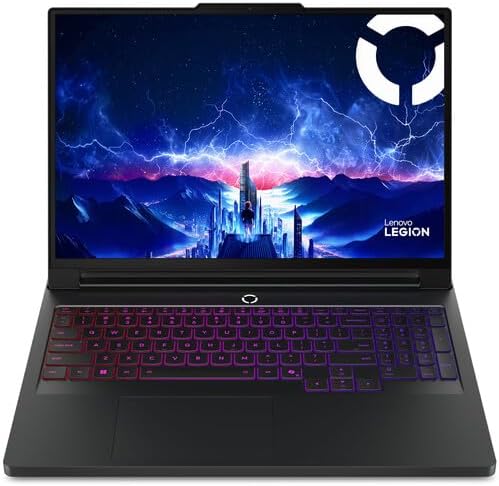
Key specs:
- CPU: Intel Core Ultra 9 275HX (24 cores, high boost clocks)
- GPU: NVIDIA GeForce RTX 5090 Laptop, 24GB GDDR7 (full 175W)
- RAM: 32GB or 64GB DDR5 — and it’s upgradeable
- Storage: Dual 1TB PCIe 4.0 NVMe slots
- Display: 16″ WQXGA (2560×1600) OLED, 240Hz, DisplayHDR True Black 1000
- Weight: About 5.7 lbs
- Price: From ~$2,399; around $3,599 with the RTX 5090
Here’s where the smart money goes, and I say that as someone who’s watched a lot of artists overspend on badges.
The Legion Pro 7i gives you a 24-core Intel HX processor and the same 24GB RTX 5090 as laptops costing a thousand dollars more — except here the GPU runs at its full 175 watts. In practice, that means your V-Ray GPU renders finish noticeably faster on this machine than on the thinner, prettier ProArt. Same silicon, more juice.
The 275HX is the real workhorse of this configuration. Twenty-four cores chew through Arnold and Corona CPU renders, while the high boost clocks keep the viewport feeling instant. And Lenovo did something almost extinct in 2026: they made the RAM upgradeable. Standard DDR5 slots mean you can buy the 32GB config today and drop in 64GB next year when the project sizes grow. Two SSD slots, same story. This machine grows with you.
Compromises? Sure. The 2560×1600 OLED is gorgeous but not 4K, the 240Hz refresh rate is pure gaming DNA that Max will never use, and under a full render this thing sounds like it’s preparing for takeoff. It’s also unmistakably a gaming laptop — RGB accents and all — which may or may not fly in your client meetings.
But if you measure laptops by render performance per dollar, nothing else on this list comes close.
Pros:
- Full-power 175W RTX 5090 — the fastest GPU rendering under $4,000
- 24-core CPU tears through Arnold, V-Ray, and Corona
- Upgradeable RAM and dual SSD slots (increasingly rare)
- Beautiful OLED panel with deep blacks
- Outstanding price-to-performance ratio
Cons:
- Loud fans and warm chassis under sustained rendering
- Display is 2.5K, not 4K
- Heavier and more “gamer” in styling than the pro options
- GeForce card is tested by Autodesk, not officially certified
3. Lenovo ThinkPad P1 Gen 8 — Best Workstation-Class
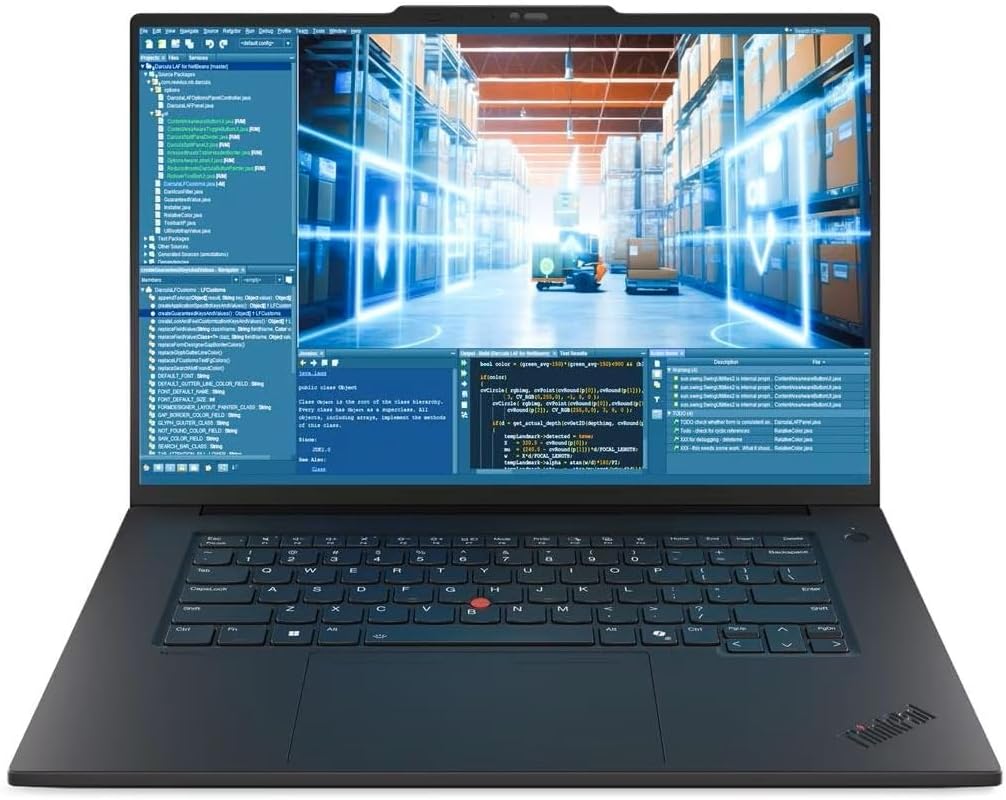
Key specs:
- CPU: Intel Core Ultra 9 285H (16 cores) or Core Ultra 7 255H
- GPU: NVIDIA RTX PRO 2000 Blackwell, 8GB GDDR7 (ISV-certified) or RTX PRO 1000
- RAM: 32GB or 64GB LPDDR5X on upgradeable CAMM2 modules
- Storage: Up to 4TB across dual M.2 slots
- Display: 16″ up to 3.2K (3200×2000) tandem OLED, 120Hz
- Weight: From about 4 lbs
- Price: From ~$3,800; well past $6,000 fully loaded
Some of you reading this work at firms where “it runs fine on my machine” isn’t good enough. You need certified drivers, IT-approved hardware, and a laptop that survives three years of daily abuse without drama. This is that laptop.
The ThinkPad P1 Gen 8 is a proper mobile workstation in a chassis that weighs about four pounds — which still feels slightly illegal to me. You get MIL-spec durability testing, the best keyboard in the laptop world (fight me), upgradeable CAMM2 memory, and NVIDIA’s RTX PRO Blackwell graphics with the professional driver branch that Autodesk officially certifies for 3ds Max. When something goes wrong at 2 a.m. before a deadline, “officially supported configuration” are three very comforting words.
Now the honest part: the RTX PRO 2000 has 8GB of VRAM and nowhere near the CUDA core count of the RTX 5090. This is not a rendering monster and it doesn’t pretend to be. It flies through the viewport, handles light GPU rendering, and runs certified-stable all day — but if you render heavy scenes locally on the GPU, this is the wrong machine. The 16-core H-series CPU tells the same story: quick in the viewport, middling for big CPU renders.
Who’s it for, then? The artist or studio whose final frames go to a render farm or a desktop tower, and whose laptop needs to be a bulletproof, certified, genuinely portable Max station. For that person, nothing else here comes close. Just brace yourself for the configurator — the price climbs fast.
Pros:
- Autodesk-certified RTX PRO graphics with professional drivers
- Genuinely portable at roughly four pounds
- Upgradeable CAMM2 memory and dual SSD slots
- Legendary keyboard and MIL-spec build quality
- Gorgeous 3.2K tandem OLED option
Cons:
- 8GB of VRAM rules out heavy GPU rendering
- 16-core CPU can’t match the 24-core HX chips for renders
- Gets painfully expensive as you spec it up
- Poor value if raw performance is your only metric
4. MSI Titan 18 HX AI — Best for Heavy Rendering
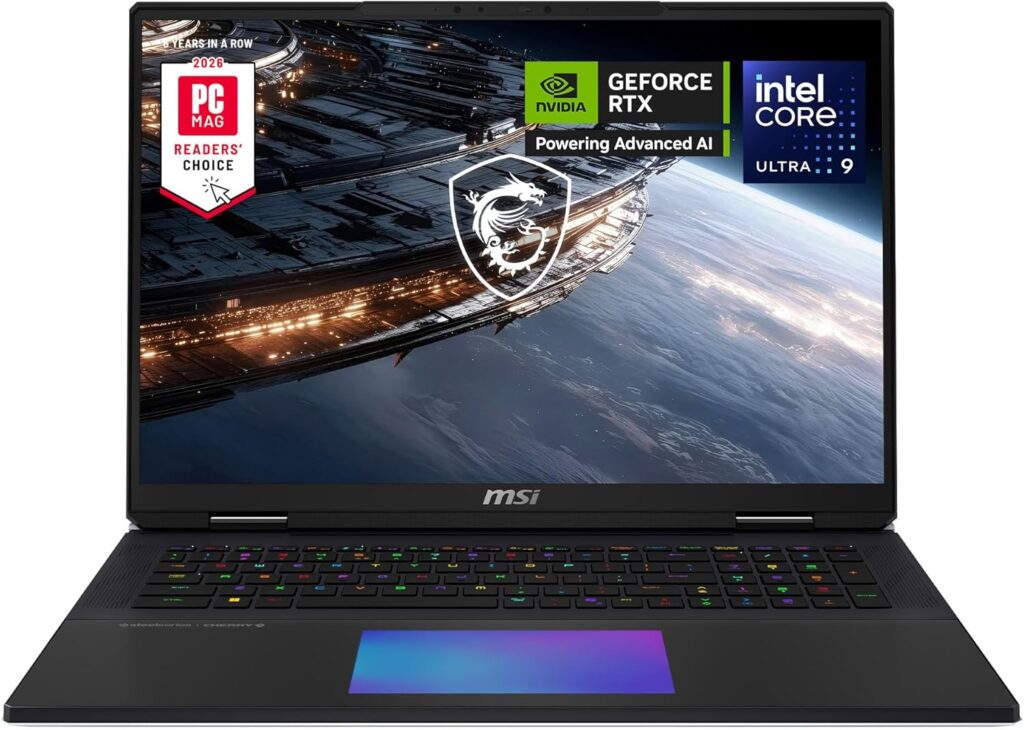
Key specs:
- CPU: Intel Core Ultra 9 285HX (24 cores, up to 5.5 GHz, sustains ~180W)
- GPU: NVIDIA GeForce RTX 5090 Laptop, 24GB GDDR7 (full 175W)
- RAM: 64GB DDR5, expandable to 96GB
- Storage: Up to 6TB across multiple SSDs, RAID-capable
- Display: 18″ UHD+ (3840×2400) mini-LED, 100% DCI-P3, DisplayHDR 1000
- Weight: About 7.9 lbs
- Price: From around $5,449
Let’s be clear about what this is: a desktop workstation that happens to fold shut. It weighs nearly eight pounds. Its battery life is a rounding error. You will not use it on a train tray table. And for a certain kind of artist, it’s the best machine on this list by a mile.
That kind of artist renders locally, a lot. Here’s why the Titan wins for them: all that chassis bulk is cooling, and cooling is what separates real sustained performance from spec-sheet fantasy. The 24-core 285HX holds around 180 watts indefinitely — no throttling, no fading twenty minutes into a render. The RTX 5090 runs at its full 175 watts. MSI’s boost mode pushes the combined system past 270 watts. Every other laptop here eventually pulls back under sustained load. This one doesn’t blink.
The result is the fastest mobile rendering setup money can buy right now — top-tier CPU throughput for Corona and V-Ray CPU, and the strongest laptop GPU configuration in existence for V-Ray GPU and Arnold GPU. The 18-inch 4K mini-LED panel is a legitimate workspace too: huge, bright, fully DCI-P3, and a joy for lighting work.
One tip from experience: always render plugged in. Like every high-power laptop, this GPU loses a big chunk of its performance on battery — I’ve seen render throughput drop by roughly 40% unplugged. That’s not a Titan flaw, it’s physics, but it matters more on a machine you bought specifically to render.
If you travel weekly, buy something else. If you want a workstation you can move when the studio relocates, this is it.
Pros:
- Highest sustained CPU and GPU power of any laptop here
- 24 cores plus a full-power 24GB RTX 5090 — mobile rendering doesn’t get faster
- Massive, beautiful 18″ 4K mini-LED display
- Up to 96GB RAM and 6TB of storage
- Cooling that actually delivers on the spec sheet
Cons:
- Nearly 8 pounds — this travels by car, not backpack
- Battery life barely worth mentioning
- Serious money
- Complete overkill if you render on a farm
5. Lenovo Legion 5 — Best Budget Option
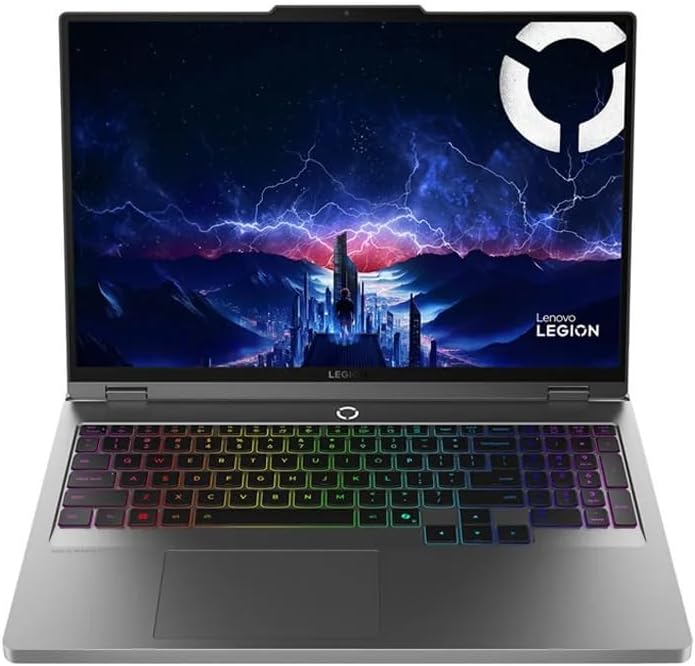
Key specs:
- CPU: AMD Ryzen 7 260 (8 cores / 16 threads)
- GPU: NVIDIA GeForce RTX 5060 Laptop, 8GB GDDR7 (up to 115W)
- RAM: 16GB or 32GB DDR5, dual slots, upgradeable
- Storage: 512GB–1TB NVMe, dual slots
- Display: 15″ WQXGA (2560×1600) OLED, 165Hz
- Weight: About 4.4 lbs
- Price: From roughly $1,149–$1,499
Not everyone needs a $4,000 render rocket, and I get a little annoyed at guides that pretend otherwise. If you’re a student learning Max, a freelancer starting out, or a professional who models on the go and renders somewhere else, the Legion 5 is the machine that runs 3ds Max properly without wrecking your finances.
That word “properly” is doing real work in that sentence. Plenty of budget laptops technically launch Max and then collapse the moment you load a real scene. The Legion 5 doesn’t. The RTX 5060’s 8GB of VRAM drives the Nitrous viewport smoothly through genuinely complex scenes, and it’ll even handle light GPU rendering if you keep textures reasonable and lean on proxies. The 8-core Ryzen keeps modeling responsive and gets modest CPU renders done overnight.
The OLED panel is the surprise at this price — punchy, contrasty, and far better than the dim panels that used to define budget machines. And like its bigger Legion sibling, both the RAM and storage are upgradeable. My strong advice: if your budget forces the 16GB configuration, plan the jump to 32GB as your first upgrade. Sixteen gigs gets tight fast once real projects start.
Know the ceiling going in: 8GB of VRAM will eventually wall you out of big GPU renders, and eight cores won’t win any CPU render races. This is a modeling, texturing, and viewport machine with rendering as a bonus. Within that lane, it punches ridiculously above its price.
Pros:
- Runs 3ds Max smoothly at a fraction of flagship prices
- 8GB VRAM handles complex viewport scenes without complaint
- Genuinely nice OLED display for the money
- Upgradeable RAM and dual SSD slots
- Portable and reasonably quiet in daily use
Cons:
- 8GB VRAM caps serious GPU rendering
- 8-core CPU is slow for heavy CPU renders
- Base 16GB RAM needs upgrading for professional work
- Not a production rendering machine, and doesn’t claim to be
Full Comparison: All 5 Laptops Side by Side
| Laptop | CPU | GPU (VRAM) | RAM | Display | Weight | Price | Best For |
|---|---|---|---|---|---|---|---|
| ASUS ProArt P16 | Ryzen AI 9 HX 370 (12c) | RTX 5090, 24GB @ 120W | 64GB | 16″ 4K OLED | ~4.3 lbs | ~$3,999 | Best overall |
| Lenovo Legion Pro 7i Gen 10 | Core Ultra 9 275HX (24c) | RTX 5090, 24GB @ 175W | 32–64GB | 16″ 2.5K OLED | ~5.7 lbs | ~$2,399–3,599 | Best value |
| Lenovo ThinkPad P1 Gen 8 | Core Ultra 9 285H (16c) | RTX PRO 2000, 8GB (certified) | 32–64GB | 16″ 3.2K OLED | ~4 lbs | ~$3,800+ | Certified workstation |
| MSI Titan 18 HX AI | Core Ultra 9 285HX (24c) | RTX 5090, 24GB @ 175W | 64–96GB | 18″ 4K mini-LED | ~7.9 lbs | ~$5,449+ | Heavy rendering |
| Lenovo Legion 5 | Ryzen 7 260 (8c) | RTX 5060, 8GB @ 115W | 16–32GB | 15″ 2.5K OLED | ~4.4 lbs | ~$1,149+ | Budget / students |
Which One Fits Your Workflow?
Architectural visualization (V-Ray, Corona, heavy scenes): ProArt P16 or Legion Pro 7i. You want the 24GB of VRAM so full scenes fit in GPU memory, and 64GB of system RAM. If the budget’s tight, the Legion’s full-power GPU gives you more render speed per dollar. If clients see your screen and you travel, the ProArt’s display and weight win.
Game asset creation (modeling, texturing, real-time engines): This work leans on the viewport and single-core speed far more than on rendering muscle, so don’t overspend. The Legion 5 covers most of it honestly. If you also bake lighting or run Substance and Marmoset alongside Max, step up to the Legion Pro 7i for the extra cores and VRAM.
Animation and rendering-heavy production: MSI Titan 18, no hesitation. Sustained 24-core CPU rendering plus the strongest mobile GPU setup, with cooling that holds it all indefinitely. If you must travel regularly, the Legion Pro 7i is the same silicon in a (slightly) more portable body.
Studio and corporate pipelines: ThinkPad P1 Gen 8. Certified drivers, IT-friendly, built like a tank, and the final frames go to the farm anyway.
Buying Tips Before You Click “Order”
- Match VRAM to your actual rendering habits. Viewport-only work is happy with 8GB. Production GPU rendering wants 24GB. Don’t pay for memory you’ll never fill — and don’t cheap out on memory you’ll hit the wall on in month two.
- Sustained power beats peak specs. The same RTX 5090 behaves very differently at 120W versus 175W. A well-cooled laptop with honest wattage beats a throttled one with a bigger badge. Read real thermal testing, not spec sheets.
- Buy 64GB of RAM if you CPU-render. It’s cheap insurance against the out-of-memory crash that always happens the night before delivery.
- Two SSDs if the laptop allows it. System on one, projects on the other. Your save times will thank you.
- Use the right driver. NVIDIA’s Studio driver for GeForce cards, the professional production branch for RTX PRO. Skip Game Ready drivers for production work — they chase game launches, not stability.
- Always render plugged in. Battery mode can cut GPU render performance by 40% or more. That “slow laptop” might just be unplugged.
- Check the panel’s actual gamut figure. “Vivid display” is marketing. “100% DCI-P3, factory calibrated” is a spec. Only one of them protects your color work.
Frequently Asked Questions
Is 32GB of RAM enough for 3ds Max?
For most professional work, yes — typical scenes rarely push past 32GB, and that’s a comfortable working floor in 2026. The exceptions are heavy, high-resolution CPU rendering and serious multitasking, where 64GB genuinely earns its keep. If you GPU-render, remember that system RAM should be at least double your VRAM, which makes 64GB the natural pairing for a 24GB graphics card.
Do I need an NVIDIA RTX GPU for 3ds Max?
For the viewport alone, no — any modern GPU with 8GB of VRAM runs Nitrous smoothly. But GPU rendering changes everything: Arnold GPU runs exclusively on NVIDIA hardware, and V-Ray GPU is built around NVIDIA’s CUDA and OptiX technology. Since Arnold ships with every copy of Max, buying NVIDIA keeps every door open. I wouldn’t buy anything else for this software.
Can gaming laptops run 3ds Max?
Absolutely — two of my five picks are gaming machines, and they’re often the best value in the entire market. The trade-offs are practical, not technical: gaming laptops are louder, flashier, and carry GeForce cards that Autodesk tests but doesn’t officially certify. On the Studio driver, they run Max beautifully. Only skip them if your studio’s pipeline demands certified hardware.
What matters more for 3ds Max: CPU cores or clock speed?
Both, for different halves of your day. Modeling, animation, and viewport work are single-threaded, so high clock speed makes the software feel fast. CPU rendering scales with core count, so more cores make renders finish fast. The best chips for Max — like Intel’s 24-core HX parts boosting past 5 GHz — deliver both. If you must choose, match the priority to where you spend more hours.
How much VRAM do I need for GPU rendering?
Here’s the unforgiving rule: your entire scene — geometry, textures, and buffers — must fit inside the GPU’s memory, or the render slows to a crawl or fails outright. For production GPU rendering, I treat 12GB as the practical minimum and 24GB as the comfortable target for complex archviz work. If GPU rendering is central to your income, buy the 24GB card and never think about it again. Viewport-only users are fine at 8GB.
Are workstation GPUs like the RTX PRO series worth it over GeForce?
Only in specific situations. 3ds Max has no secret features that unlock on professional cards — you’re paying for ISV certification, official Autodesk support, and enterprise driver stability. For studios that require certified hardware, that’s worth real money. For everyone else, a GeForce card on the Studio driver delivers equal or better rendering performance for far less. I’d rather see most artists spend the difference on more RAM and a second SSD.
Should I buy a thin creator laptop or a thick desktop replacement?
It comes down to one question: how much do you render locally? Thin machines run their GPUs at reduced wattage — around 120W — trading render speed for portability. Thick machines sustain full power and finish renders meaningfully faster, at the cost of weight and battery life. If final frames go to a farm or a desktop, buy thin and enjoy your shoulders. If your laptop is your render box, buy thick and buy a good bag.
The Bottom Line
After all of that, my advice comes down to something pretty simple. Most 3ds Max artists in 2026 should buy the ASUS ProArt P16 — the display, the 24GB GPU, and the portability make it the machine you’ll be happiest with a year from now. If your budget is doing the deciding, the Lenovo Legion Pro 7i Gen 10 delivers the most rendering power per dollar of anything on the market, full stop.
The rest are specialists: the MSI Titan 18 if local rendering throughput is everything, the ThinkPad P1 Gen 8 if certification and reliability run your purchasing decisions, and the Legion 5 if you’re building skills before building a budget.
Whatever you choose, buy for your actual workflow — the hours you really spend modeling versus rendering versus traveling — instead of the biggest number on the box. Get that match right, and 3ds Max finally becomes what it should have been all along: a fluid, responsive tool that keeps up with your ideas instead of fighting them.

Hi, my name is Burak. I am a mechanical engineer. I have been writing laptop reviews for the Engineering Laptops website since 2020. Please feel free to contact me if you have any questions.